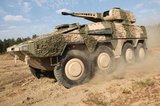
Why Middle Eastern markets demand bespoke AFV solutions
In this expert analysis, Christopher Foss looks at how armoured vehicle suppliers to the Middle East are increasingly tailoring platforms for the region’s specific operational requirements.
Javelin ATGM being fired by US troops in a demonstration in Pabrade, Lithuania. (Photo: US Army)
Lithuania is set to receive an additional 230 FGM-148F Javelin anti-tank guided missiles (ATGMs) and 20 Javelin Command Launch Units (CLUs) from the Raytheon/Lockheed Martin Javelin JV under the FMS programme, pending approval from Congress.
A previous FMS case (worth $28.23 million) included 111 ATGMs and ten CLUs, the State Department noted on 21 December.
Also included in the latest FMS proposal are battery chargers, an enhanced basic skills trainer system, other training services, plus logistics and support equipment and services.
The total estimated cost is $125 million.
The proposed sale will help Lithuania build its long-term defence capacity, the State Department claimed, adding that it is ‘vital’ for the US to support efforts by the Baltic republic ‘to defend its sovereignty and territorial integrity’.
An advanced multi-purpose warhead on the F-model Javelin delivers increased lethal effects against soft and lightly armoured targets, with an improved penetration capability against explosive reactive armour.
In this expert analysis, Christopher Foss looks at how armoured vehicle suppliers to the Middle East are increasingly tailoring platforms for the region’s specific operational requirements.
More than a year after selecting the KNDS Artillery Gun Module mounted on the Piranha IV 8x8 as its next artillery system, Switzerland is still awaiting the contract that will deliver the guns.
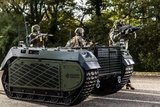
Milrem’s THeMIS uncrewed ground vehicle is one of the most battle-proven medium UGV platforms in service, with the company looking to have production versions of new large platforms ready before the end of the decade.
CENTCOM confirmed that PrSMs have been deployed in the offensive against Iran, bringing what it called “an unrivalled deep strike capability”.
Defence buyers globally are increasingly looking to tie domestic manufacturing and technology transfer into deals.
This month we saw a major presence from Turkish, Russian and Chinese companies at the World Defense Show with new vehicles from major suppliers, while elsewhere there were evolving mortar programmes and artillery modernisation efforts.