Eurosatory 2026: Vegvisir sets connectivity in contested environments in its sights
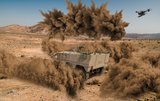
Vegvisir's communications technology is designed to support seamless connectivity while giving commanders greater visibility over crewed and uncrewed systems. (Photo: Vegvisir)
Maintaining connectivity in contested environments, where essential networks can easily be disrupted by enemy forces, has emerged as a key challenge in modern warfare. Estonian company Vegvisir aims to tackle that problem with a new Communications Module unveiled at Eurosatory.


According to Vegvisir, the Communications Module has already secured an initial customer in Europe, highlighting growing demand for solutions to a problem affecting forces using increasingly network-dependent crewed and uncrewed systems.
“One of the key lessons from the war in Ukraine is that connectivity can no longer be taken for granted. Armed forces rely on a growing mix of drones, unmanned vehicles and autonomous systems, but these platforms are only effective if they remain connected to operators and commanders,” emphasised Ingvar Pärnamäe, co-founder and CEO of Vegvisir.
The module automatically manages and prioritises channels, including 5G, 4G, wi-fi, StarLink and other networks. Should a network become unavailable, the system switches to an alternative connection, requiring no operator intervention to do so.
It incorporates dual-modem failover capability, uses integrated omnidirectional antennas, is ruggedised for harsh environments, and is compatibile with fibre-optics for electronic warfare-resistant, radio frequency-silent operations.
Vegvisir’s communications systems have been tested or deployed in countries including Estonia, Finland, Latvia, Belgium, Norway, the Netherlands, the UK, the US and Australia. The Australian Army, is the largest customer to date, and uses the technology for experimentation with optionally crewed M113 armoured vehicles.
Building on this work with land systems, Vegvisir is extending its situational awareness and command platform to air, surface naval and underwater operations, enabling units to manage assets across multiple domains.
“One of the biggest challenges of modern warfare is making manned and unmanned assets work together effectively,” Pärnamäe said. Vegvisir’s Virtual Command Station allows commanders to access live feeds, maps and mission data from multiple platforms in a single operational environment, instead of using traditional physical command posts with multiple screens and stovepiped systems.
This is designed to improve crewed-uncrewed teaming, and reduce the manpower required to support autonomous systems. It gives commanders a “clearer understanding of where assets are, what they see and how they contribute to the mission,” added Pärnamäe.




More from Eurosatory 2026
-
![Eurosatory 2026: Milrem Robotics puts forward multi-layered defence concept for NATO's eastern flank]()
Eurosatory 2026: Milrem Robotics puts forward multi-layered defence concept for NATO's eastern flank
Autonomous systems developer Milrem has evolved a model for an interoperable robotised approach to the Eastern Flank Deterrence Initiative (EFDI), showing how uncrewed systems could provide a multi-layered defence architecture in the air and on land along NATO’s eastern borders.
-
![Eurosatory 2026: AM General highlights UGV and JLTV A2]()
Eurosatory 2026: AM General highlights UGV and JLTV A2
AM General is showcasing its autonomous ground vehicle and latest light tactical vehicle at Eurosatory 2026, highlighting counter-drone capabilities, modular mission systems and improvements in battlefield mobility.
-
![Eurosatory 2026: Arclin and BSST unveil lighter EOD suit as bomb disposal market burgeons]()
Eurosatory 2026: Arclin and BSST unveil lighter EOD suit as bomb disposal market burgeons
Arclin and BSST have developed a lighter explosive ordnance disposal (EOD) suit using Kevlar EXO technology to improve operator mobility while maintaining protection against fragmentation threats.
-
![Eurosatory 2026: Updated S-KAPS ready to neutralise drone threat]()
Eurosatory 2026: Updated S-KAPS ready to neutralise drone threat
Launched at EuroSatory 2026, the revamped Soft-Kill Advanced Protection System (S-KAPS) counter-UAS package has been developed by three French SMEs, Lacroix, Bertin Technologies and MC2 Technologies as a private venture.
-
![Eurosatory 2026 to highlight changing defence and security priorities]()
Eurosatory 2026 to highlight changing defence and security priorities
Eurosatory 2026 will reflect a defence and security sector shaped by conflict, rising government spending, uncrewed systems, multidomain networks and growing demand for sovereign capabilities.