“A staggering rate of change”: how experience combating IEDs is being applied to the C-UAS arena
The scale of the current escalation in drone attacks is fuelling demand for C-UAS technology that must address a rapidly evolving and expanding threat. Against this background, important lessons can be learned from the battle against IEDs, with networked responses and dispersed capabilities essential to deliver enduring protection.


This In Conversation interview is brought to you by Shephard in partnership with OpenWorks.
Speaking to Shephard’s Gerrard Cowan, James Cross, co-founder and Chief Commercial Officer (CCO) at OpenWorks, described the rapidly expanding UAS challenge as “the number one threat” to militaries. “Anybody can have an air force today, for surveillance, attack or intercept,” he said. “You don’t have to be a modern military from a major economy.”
Cross pointed to the use of drones in the war in Ukraine. Their impact in the region had been evident for years, he noted, but has expanded hugely since the launch of the full-scale invasion in February 2022, with tens of thousands of drones produced in Ukraine alone on a weekly basis.
“The rate of change is staggering. Innovations are coming to the front line in weeks, not months,” he noted.
The impact is not limited to that theatre. It can also be seen in the Middle East, Cross added, including in the fallout from the conflict between Iran, the US and Israel. In particular, he highlighted the use of drones against civilian targets – such as hotels – in countries like the UAE.
“The Middle East conflict has changed the risk perception for other states,” he explained. “That backs up the move by European nations to invest so much in C-UAS and air defence today.”
Learning from the past
The growing danger posed by huge volumes of low-cost drones is analogous to the use of IEDs in Iraq and Afghanistan, Cross said. Both threats have driven tactics on the front line in their respective contexts: just as soldiers in Afghanistan had to adapt routes for supply convoys and vehicles, so troops in Ukraine heavily rely on underground infrastructure to avoid first-person view (FPV) drones and other uncrewed dangers.
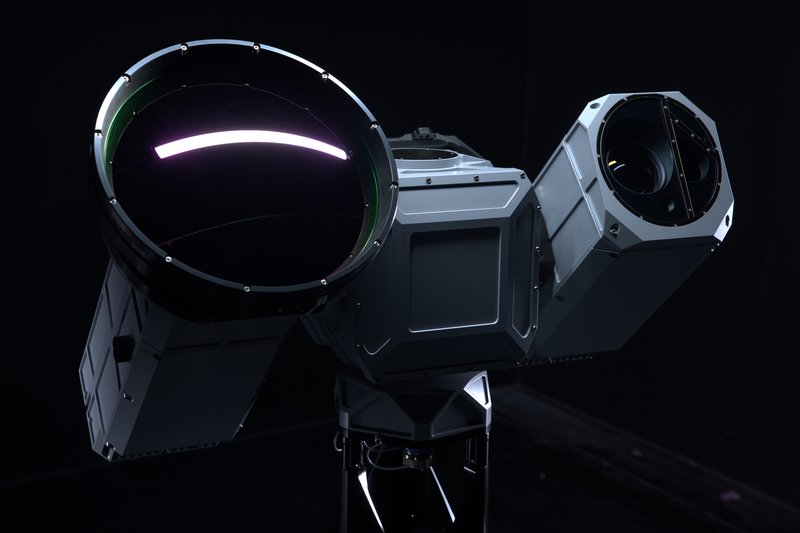
Image credit: OpenWorks Engineering
“The UAS threat is in many ways an IED, but with far greater reach and flexibility,” Cross noted. “If you spend more than five minutes exposed at the front line, an ISR UAS has seen you. It’s completely transformed warfare.”
The similarities are particularly true when it comes to the “cost asymmetry paradox”, he added: the fact that a cheap drone can threaten a military platform or infrastructure potentially worth millions of dollars.
“Ultimately, it’s a war of economics. If it costs £2 million to defend a £100 million investment, that might seem to make sense in isolation, but it doesn’t at scale.”
Networked response
So how can militaries address this wide-ranging and rapidly evolving scenario? For OpenWorks, the solution is to pursue a networked response, an approach that is proving its effectiveness in Ukraine.
This involves integrating networks of sensors – from radars and acoustic payloads all the way through to an app on a mobile phone – to provide a comprehensive picture of the battlespace. That data is then fed into a battle management system (BMS) to allow operators to track the movement of threats, before handing over to defeat capabilities, which could range from anti-aircraft guns to dedicated C-UAS effectors.
This demands a suite of sensors that work together, delivering maximum speed with a minimum false alarm rate and the lowest possible demand on operators.
“A network of sensors and effectors developed in a very coherent way, together with careful data fusion and high levels of autonomy, is what the militaries of today need,” Cross said. “That inspires us when it comes to technology development in our equipment today.”
Industrial evolution
C-UAS has been a core focus for OpenWorks since the company was founded in 2015. Built up by experts who originally started in the counter-IED and combat engineering sector, the business has a unique vantage point on the evolution of the C-UAS threat to military personnel and the advantages of a networked response.
This has evolved along with UAS in the battlespace, explained Cross. The company’s first product was the SkyWall system, comprising handheld devices that capture drones in nets to avoid the need for electronic countermeasures. This was designed to address a specific problem, he said: the threat from drones which cannot be jammed.
The development of SkyWall evolved into a focus on autonomous optical systems, stimulated by End User demand, designed to sit within the networked response that the drone threat requires. This is the company’s “Vision” family.
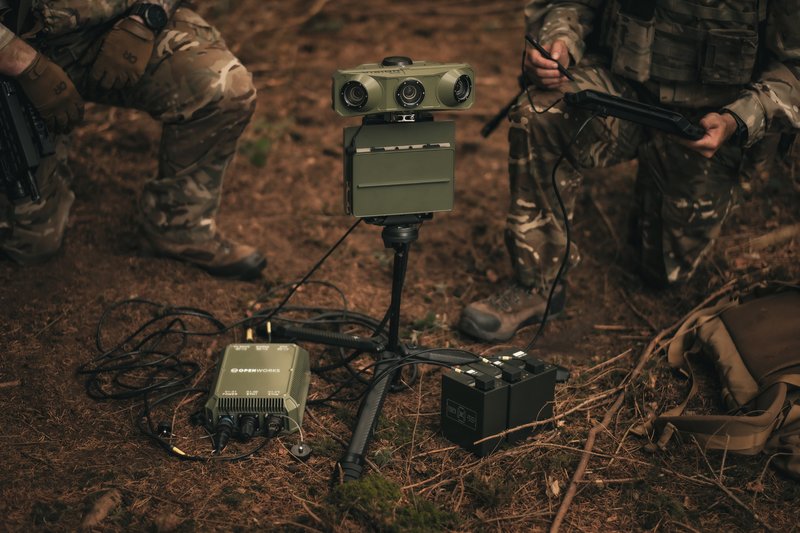
Image credit: OpenWorks Engineering
Cross pointed to Vision Guard, a compact sensor package that integrates AI and data fusion software to detect, track and identify class 1 UAS at long range. Vision Guard is designed to minimise size, weight and power (SWAP) demands, combining systems such as radar and acoustic sensors into a form factor that can be carried in a standard military backpack and deployed in under two minutes.
Networked response and dispersed capability are at the heart of Vision Guard. Through protocols like ATAK, the system can transmit data on detected threats to a BMS, placing it into the wider operational context. “That is what makes the difference in a modern environment where threats change so quickly and can come in such volume,” added Cross.
Commercial and dynamic
Vision Guard is just one element of a wider family of systems. Cross also highlighted Vision Flex, which can be mast-mounted on vehicles and vessels, for missions such as base defence. It also combines AI modules with electro-optical and infrared (EO/IR) payloads, as well as other sensors as required.
The third major product line is Vision Pace. This is designed to be installed on vehicles, vessels and turret systems to provide high levels of targeting and tracking performance. Because its high-quality data can be put directly into a connected effector with low latency, “you only need the minimum number of engagements to defeat the target,” said Cross, a key priority when faced with the cost asymmetry of drones.
The technology is developed “in a commercial and dynamic manner,” he emphasised; importantly, the optical systems are cost-effective, a vital consideration in this context.
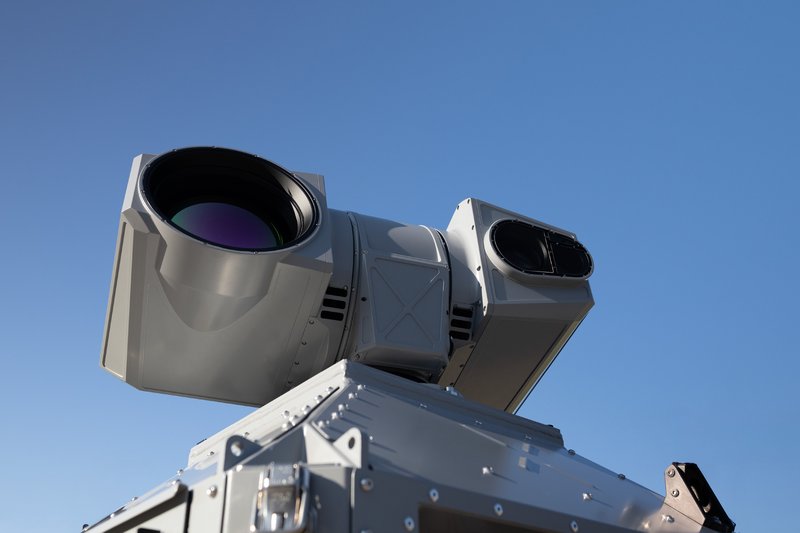
Image credit: OpenWorks Engineering
All these systems are designed to maximise C-UAS capabilities in a complex, rapidly evolving battlespace. Dispersal of capability via on-the-move protection is a crucial priority, noted Cross, providing operators with the ability to defend themselves on the move by detecting, tracking and identifying drones, while also providing an ability to engage targets.
The product line has now expanded to include Vision Pace Radar, which integrates a high-precision radar to the family. This new system will be on display at OpenWorks’ stand at Eurosatory in June 2026, said Cross.
Vision Pace Radar helps further reduce the cost of effector platforms, he noted, providing optimum targeting data to vehicles or C-UAS systems without the need for multiple additional high-precision radars.
“Now when we’re tracking drones with the optics, we can also track multiple other drones with the targeting radar. By adding a radar onto the platform, we’ve got multiple ways of measuring where that drone is and providing that robust targeting data to other systems,” Cross said.
Partnership-led philosophy
The need to integrate a wide network of sensors, vehicles and effectors means that C-UAS capabilities are rarely developed by one company in isolation. Cross stressed OpenWorks’ commitment to a partnership-led philosophy, working with companies like BAE Systems, Thales, Diehl and MBDA to adapt systems to the needs of individual customers.
“The best counter-drone systems have a lot of involvement from primes, SMEs and specialists, whether that be radar manufacturers, electronic warfare developers, or indeed, our optical experts.”
This partnership-driven thinking extends to collaboration with the End User, he noted. OpenWorks relies on close relationships with such customers as the UK Ministry of Defence, the FBI in the US and Germany’s Federal Police.
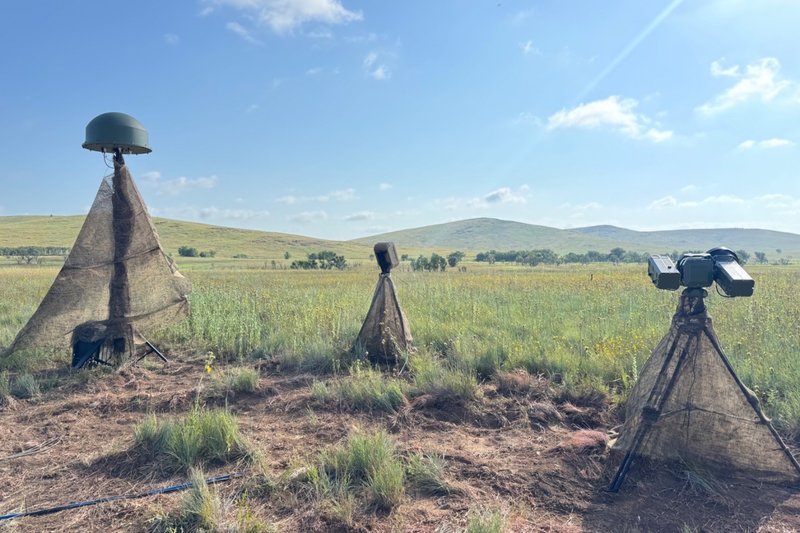
Image credit: Aaronia
“Without working closely with the End User, they don’t know what we can do, and we don’t know what they want,” Cross said. “We are very open as a company and will happily invite End Users to our test range to see our prototypes and pre-production units to get their feedback as early as possible.”
Investing for the future
There is little doubt that the UAS threat will not only endure but continue to expand and evolve. It is in many ways a “cat and mouse game”, according to Cross.
“The threat will change based on what people deploy to defeat it, meaning we need to be dynamic. That’s why small, agile companies with a lot of innovation are well placed in this world.”
OpenWorks will continue to invest in its own manufacturing capabilities to help meet the challenge, he added. It is now bringing a second production facility on line at its base in Northumberland, north-east England, he said, giving it the capacity to rapidly step up delivery rates as required.
Additionally, he underlined the company’s commitment to invest heavily in component stocks, meaning it can deliver its autonomous optical systems in volume off-the-shelf.
OpenWorks has experienced rapid growth in recent years, Cross concluded, expansion supported by the UK government and major primes. This fact and the company’s deepening partnerships reflect the changing military landscape and the increasing need for effective C-UAS.
“It’s critical at this stage that defence companies within NATO can step up to meet increased demand,” he said. “While we love talking about technology, you’ve got to be able to build it at pace and at short notice, and we are investing to ensure we can do that.”
For more information, visit www.openworksengineering.com


More from Industry Spotlights
-
![Patria OPTIME and ILIAS: Orchestrating operational readiness across every domain]()
Patria OPTIME and ILIAS: Orchestrating operational readiness across every domain
Patria OPTIME is a sustainment concept that integrates MRO and lifecycle services into one solution, powered by the ILIAS digital defence platform
-
![“Start planning much earlier”: delivering defence support in an era of disruption]()
“Start planning much earlier”: delivering defence support in an era of disruption
In Conversation… The geopolitical landscape is increasingly uncertain, with the UK and its allies confronting the most unpredictable international environment for decades. To adapt, defence readiness must begin long before assets reach the front line, forging a resilient support enterprise that can thrive in a time of ongoing disruption, argue the partners of Team ORION.
-
![Patria NEMO Navy: Unlocking unmatched versatility and protection for modern naval forces]()
Patria NEMO Navy: Unlocking unmatched versatility and protection for modern naval forces
The Patria NEMO Navy mortar system marks a revolutionary advance in maritime defence technology, offering unparalleled benefits to customers who demand performance, adaptability and safety in their naval operations.
-
![“Communicating at mission speed”: why data security is essential for operational success]()
“Communicating at mission speed”: why data security is essential for operational success
In conversation… Everfox’s Chairman and Chief Executive Officer Dave Wajsgras and Managing Director, International, Colin McKinty discuss the critical importance of information security in defence, minimising insider risk and the company’s international growth strategy with Shephard’s Andrew White.
-
![“Engage with the operational problem”: how software innovation can boost UK defence]()
“Engage with the operational problem”: how software innovation can boost UK defence
In Conversation… Shephard’s Andrew White talks to Zafer Şen, CEO and co-founder of OBSS, about the future of command-and-control software in the age of artificial intelligence, and his company’s ambitions in the UK defence market.
-
![“A survivable architecture”: why resilient communications are no longer a luxury]()
“A survivable architecture”: why resilient communications are no longer a luxury
In Conversation… Military communications must adapt to a rapidly evolving battlespace, characterised by decentralised forces and an increasingly contested electromagnetic spectrum. To survive and thrive, it is vital to prioritise resilient systems and networks, Faisal Munir, President – Mission-Critical Communications at L3Harris Technologies, told Shephard’s Gerrard Cowan.