DSEi 2011: CVR(T) upgraded for Afghanistan
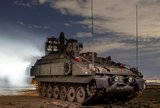
All of the British Army CVR(T) vehicles upgraded to Mk 2 standard are now in Afghanistan, as contractor BAE Systems outlined details of the project at the DSEi exhibition in London.
Speaking to reporter at the exhibition on 15 September, company officials outlined a range of upgrades to 58 of the CVR(T) family, including the Scimitar reconnaissance vehicle, under the £30 million project.
Simon George, BAE export account manager for military and technical services, said this latest upgrade programme, under a project dubbed ‘Project Transformer’, followed the deployment of CVR(T) vehicles to Afghanistan in 2009 that had been enhanced to operate in the harsh conditions in theatre.
Enhancements then included an uprated engine, improved transmission, higher ratio final drives, a new cooling system and a revised air intake system.
George said the upgraded vehicle was well received and, with the role the CVR(T) was expected to play in support of ongoing operations in Afghanistan, the further improvement plan was launched, with contract award in December 2010.
Survivability requirements play a significant part of the Mk 2 design, with a new hull based on the Spartan troop carrier providing improved mine blast protection. The new aluminium alloy, which is fabricated at the company’s Wolverhampton site, has greater resistance to corrosion while keeping the weight down.
The extra headroom has allowed the fitting of blast attenuating seating ‘in every position in every variant’.
In addition, redesigned and repositioned driver foot controls aim to reduce lower limb mine blast injuries while improved appliqué armour has been added to improve blast and ballistic protection.
According to company literature ‘a new power distribution system, including a new rotary base junction, provides improved power management between chassis and turret and will enable further systems upgrades in the future’.
Other minor changes have been introduced to the supporting vehicles in the family, such as a heavier-duty winch on the Samson variant.
Tim Barnard, team leader for platforms at Defence Equipment and Support (DE&S), said there had been a number of earlier feasibility studies in how to increase the protection of the Mk 1 vehicles
‘Once we decided to go down the route we have it was a year-long, very hectic, very intense programme. The vehicles have only been out there for about a month and the proof in the pudding will be how they perform - if they are used heavily then clearly there will be attrition and we will need more of them.’
BAE Systems is displaying the upgraded vehicle at DSEi and, with more than 2000 CVR(T) vehicles in service around the world, is looking to market the upgrades to export customers.




More from Land Warfare
-
![Europe commits to long-range fires but countries move in different directions]()
Europe commits to long-range fires but countries move in different directions
Sweden, Croatia and France are pursuing different rocket artillery solutions as European armies seek greater reach, survivability and industrial resilience.
-
![Polaris expands Arctic mobility offering as US military orders grow]()
Polaris expands Arctic mobility offering as US military orders grow
The Military 850 Voyageur 155 Crossover has secured orders from the US Army, Air Force and Marine Corps, addressing demand for agile Arctic mobility with passenger, cargo and towing capacity.
-
![Northrop Grumman pushing ahead with smaller Integrated Battle Command System]()
Northrop Grumman pushing ahead with smaller Integrated Battle Command System
Northrop Grumman’s Integrated Battle Command System is in service with Polish forces and is being introduced to US forces, with further development underway on the original platform as well as a smaller, more mobile system.
-
![UK’s ground-based air defence effort remains in assessment phase after third industry day]()
UK’s ground-based air defence effort remains in assessment phase after third industry day
The UK’s plan to introduce a new air defence capability into the British Army will cover short and medium-range defence as well as counter-uncrewed aerial system systems. Timelines are not yet laid out but industry is making plans.