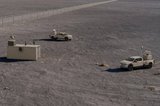
DRDO successfully fires Nag ATGM
India’s Defence Research and Development Organisation (DRDO) has successfully test-fired the indigenously developed third generation Nag anti-tank guided missile (ATGM) in the ranges of Rajasthan, India.
The test firing saw the ATGM missile twice successfully strike targets at different ranges and conditions with high accuracy.
The Nag ATGM is a new generation vehicle-mounted fire-and-forget missile with advanced imaging infrared radar seeker and integrated avionics.
Following the successful flight trials, along with the flight test conducted in June, the complete functionality of the Nag ATGM along with launcher system NAMICA has been established, marking the successful completion of development trials of the missile.





More from Land Warfare
-
![Front-line support: how UK industry is helping tackle Ukraine’s landmine challenges]()
Front-line support: how UK industry is helping tackle Ukraine’s landmine challenges
Pearson Engineering has provided equipment and engineering expertise to the Armed Forces of Ukraine since the beginning of the full-scale Russian invasion in 2022. The British company is now working to deepen engagement with the Ukrainian defence industry, expanding its support for the country’s population and laying the foundations for future technological innovation.
-
![AUSA 2026: industry looks to make commercial platforms a military reality]()
AUSA 2026: industry looks to make commercial platforms a military reality
With a production rate of more than 10 million vehicles annually, the US commercial car and vehicle manufacturing base is second only to China. Defence companies are looking at how the vehicles, technology and manufacturing capability can support programmes.
-
![With changing patterns in Middle Eastern procurement, is Europe missing out?]()
With changing patterns in Middle Eastern procurement, is Europe missing out?
Traditional suppliers are struggling to meet the Middle East’s armoured vehicle modernisation needs, creating opportunities for South Korean manufacturers and regional defence industries.
-
![AUSA 2026: CUAS market expands as suppliers target new threats and operational requirements]()
AUSA 2026: CUAS market expands as suppliers target new threats and operational requirements
New developments from MARSS, MyDefence, Mountain Horse Solutions and Rafael suggest that future counter-drone protection will increasingly depend on combining advanced detection, rapid interception and integrated defensive networks.