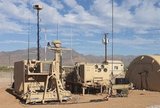
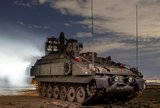
DAGR missile launched from JLTV prototype


Lockheed Martin has demonstrated the ability of its DAGR missile to launch from a pedestal launcher mounted on in the bed of a ground vehicle. The latest flight tests for the precision-strike, multi-role, multi-platform munition were conducted from a Joint Light Tactical Vehicle (JLTV) prototype at Eglin Air Force Base.
The tests saw DAGR and two Hydra 70 rockets launched from the JLTV. According to the company, DAGR locked onto the laser spot two seconds after launch, flew 5 km down range and impacted the target within 1 meter of the laser spot. The unguided Hydra 70 rockets were launched down the centre of the range, and flew 521 and 2,600 meters, respectively.
These most recent tests showed DAGR’s ability to provide a ‘high-precision defensive capability to the surface combat arena when paired with the pedestal launcher and a mobile ground platform like the JLTV’, Ken Musculus, director of close combat systems at Lockheed Martin Missiles and Fire Control, said.
Lockheed Martin’s pedestal launcher features four M299 launcher rails, associated cables and electronics, providing full compatibility with Hellfire II and DAGR missiles. DAGR’s rail-mounted canister attaches to the pedestal launch rails as it would on a standard Hellfire launcher designed for aircraft.
DAGR incorporates proven Hellfire II technology into a 2.75-inch/70 millimetre guidance kit that integrates seamlessly with legacy Hydra-70 rockets. The result is a laser-guided missile that puts a 10-pound warhead within one meter of the laser spot, defeating high-value, non-armoured or lightly-armoured targets while minimising collateral damage. DAGR’s lock-on-before launch mode ensures the missile identifies the correct target prior to launch.
Lockheed Martin has conducted 40 DAGR flight tests from ranges of 1 to 5.1 kilometres. DAGR has been launched from multiple Hellfire-equipped rotary-wing platforms, including the AH-64D Apache, AH-6 Little Bird and OH-58 Kiowa Warrior. It has been launched from the pedestal launcher in three guided flight tests and five flights in total.



More from Land Warfare
-
![Polaris expands Arctic mobility offering as US military orders grow]()
Polaris expands Arctic mobility offering as US military orders grow
The Military 850 Voyageur 155 Crossover has secured orders from the US Army, Air Force and Marine Corps, addressing demand for agile Arctic mobility with passenger, cargo and towing capacity.
-
![More bidders move onto starting grid for British Army Land Rover replacement programme]()
More bidders move onto starting grid for British Army Land Rover replacement programme
The Light Mobility Vehicle segment of the UK’s Land Mobility Programme for the British Army may actually be about to make progress, or at least likely bidders seem to think so. Shephard spoke with several contenders who revealed their views on how the army should replace the ageing fleet.
-
![Northrop Grumman pushing ahead with smaller Integrated Battle Command System]()
Northrop Grumman pushing ahead with smaller Integrated Battle Command System
Northrop Grumman’s Integrated Battle Command System is in service with Polish forces and is being introduced to US forces, with further development underway on the original platform as well as a smaller, more mobile system.
-
![UK’s ground-based air defence effort remains in assessment phase after third industry day]()
UK’s ground-based air defence effort remains in assessment phase after third industry day
The UK’s plan to introduce a new air defence capability into the British Army will cover short and medium-range defence as well as counter-uncrewed aerial system systems. Timelines are not yet laid out but industry is making plans.