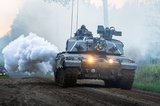
BAE Systems to continue work on active protection system for US Army
Terra Raven will form part of MCSKS. (Image: BAE Systems)
BAE Systems Multi-Class Soft Kill System (MCSKS) countermeasure system has been designed to provide protection without the need for kinetic effort and will reduce the logistic chain required for protection.


The US Army has awarded BAE Systems a follow-on contract to continue development of the company’s MCSKS countermeasures system which has been designed to protect vehicles against guided missiles and similar threats.
BAE Systems will further develop its laser-based Stormcrow and Terra Raven countermeasure systems as part of an effort to move forward the US Army’s electronic warfare (EW)-based active protection system (APS) efforts.
The laser-based defence allows for conservation of kinetic weapons and provides a less expensive option once fielded.
Terra Raven is part of a layered defence and response approach designed to be integrated into current and next-generation combat vehicles and provide laser-based countermeasures.
Coupled with BAE Systems’ 360 MVP Sensor situational awareness suite, the infrared countermeasures system detects, tracks and engages incoming threats to armoured ground vehicles.
BAE Systems has worked previously with the US Department of Defense on similar efforts such as the Advanced Layered Soft Kill System and the Layered Soft Kill System development programmes which resulted in demonstrations.
APS has become a key feature of a range of new vehicle and upgrade programmes in the light of asymmetric conflicts, such as in Syria last decade or recent operations in Gaza and conventional conflict such as Russia’s attack on Ukraine.
The US Army’s upgraded Bradley’s are being fitted with Elbit Systems’ Iron Fist APS and upgraded Turkish Leopard 2A main battle tanks will soon be delivered with Aselsan’s AKKOR (AKtif KORuma) APS.

More from Land Warfare
-
![DVD 2026: British Army’s Ajax back in the hands of users as part of a gradual return]()
DVD 2026: British Army’s Ajax back in the hands of users as part of a gradual return
The introduction of Ajax vehicles into British Army service was stopped after operator health issues were reported during an exercise, but manufacturer General Dynamics Land Systems UK believes work over the past 10 months has dealt with the problems.
-
![Europe commits to long-range fires but countries move in different directions]()
Europe commits to long-range fires but countries move in different directions
Sweden, Croatia and France are pursuing different rocket artillery solutions as European armies seek greater reach, survivability and industrial resilience.
-
![MAAF to test Britain’s shift from armour to distributed lethality in Estonia]()
MAAF to test Britain’s shift from armour to distributed lethality in Estonia
The bilateral agreement between the UK and Estonia comes as both countries explore how dispersed troops, drones, digital targeting, anti-tank weapons and increasingly long-range fires can complement the combat mass traditionally provided by heavy armour.