AUSA 2022: Long-range PGK passes test with Extended Range Cannon Artillery
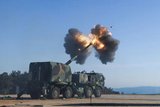
The Long Range Precision Guidance Kit from BAE Systems features GPS anti-jam technology that corrects inherent ballistic errors with firing high-explosive and rocket-assist artillery projectiles. (Image: BAE Systems)
The Long-Range Precision Guidance Kit from BAE Systems has completed survivability tests with the Extended Range Cannon Artillery for the US Army.


BAE Systems has successfully fired its Long-Range Precision Guidance Kit (LR-PGK) for 155mm artillery projectiles from the US Army’s Extended Range Cannon Artillery (ERCA) at Yuma Proving Ground in Arizona.
The firing demonstrated ‘airframe structural survivability under extreme firing conditions’, the company announced during AUSA 2022 on 10-12 October.
It added that the ERCA survivability tests ‘are a critical milestone for LR-PGK’ as it demonstrated an ability to hit targets accurately at up to 70km range — a key long-range precision fires requirement for the US Army.
LR-PGK improves the accuracy of unguided artillery projectiles with low-cost navigation and guidance technology.
The guidance kit, which is compatible with existing and planned artillery projectiles, combines anti-jam GPS sensors with control planes that enable projectile manoeuvrability throughout flight.
BAE Systems is now focusing on long-range guidance, navigation, and projectile flight control.
PGKs for the US Army must demonstrate the ability to operate at high spin rates, in challenging atmospheric conditions, and in the presence of enemy signal-jamming.
Related Programmes in Defence Insight


More from Land Warfare
-
![Polaris expands Arctic mobility offering as US military orders grow]()
Polaris expands Arctic mobility offering as US military orders grow
The Military 850 Voyageur 155 Crossover has secured orders from the US Army, Air Force and Marine Corps, addressing demand for agile Arctic mobility with passenger, cargo and towing capacity.
-
![More bidders move onto starting grid for British Army Land Rover replacement programme]()
More bidders move onto starting grid for British Army Land Rover replacement programme
The Light Mobility Vehicle segment of the UK’s Land Mobility Programme for the British Army may actually be about to make progress, or at least likely bidders seem to think so. Shephard spoke with several contenders who revealed their views on how the army should replace the ageing fleet.
-
![Northrop Grumman pushing ahead with smaller Integrated Battle Command System]()
Northrop Grumman pushing ahead with smaller Integrated Battle Command System
Northrop Grumman’s Integrated Battle Command System is in service with Polish forces and is being introduced to US forces, with further development underway on the original platform as well as a smaller, more mobile system.
-
![UK’s ground-based air defence effort remains in assessment phase after third industry day]()
UK’s ground-based air defence effort remains in assessment phase after third industry day
The UK’s plan to introduce a new air defence capability into the British Army will cover short and medium-range defence as well as counter-uncrewed aerial system systems. Timelines are not yet laid out but industry is making plans.