WNW Anti-Jam Mode successfully tested on PHOENIX radios


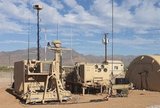
BAE Systems has tested its mid-tier PHOENIX networking radios at Joint Base McGuire-Dix-Lakehurst (Fort Dix) in an effort to enhance the ability of warfighters to securely and reliably communicate battlefield information via jam-resistant waveforms. The company reported positive results on the over-the-air field tests.
BAE Systems is the developer of the Wideband Networking Waveform (WNW) Anti-Jam (AJ) mode for the US Department of Defense. These tests were conducted within the scope of a Cooperative Research and Development Agreement (CRADA) between the US Army Communications-Electronics Research, Development and Engineering Center (CERDEC), and BAE Systems.
PHOENIX radios allow soldiers to communicate voice, data, and video for enhanced battlefield awareness. This family of software-defined radios includes three programmable variants, each of which uses the next-generation, government-owned WNW and Soldier Radio Waveform (SRW), and allows multiple configurations: two-channel with SINCGARS, two-channel, and four-channel.
With the robust WNW, all PHOENIX variants provide full anti-jam modes to protect communications in hostile environments and when using jammers. The off-the-shelf radio system has been developed to offer a low size, weight, and power solution that can be easily integrated with the SINCGARS radio space already allotted on US Army ground combat vehicles.
Christopher A Ager, director of Networked Communications at BAE Systems, said of the tests: ‘Protecting tactical communications is fundamental to maintaining battlefield advantage. Our expertise with the Anti-Jam mode of WNW is evident in the positive results of our field testing at Fort Dix. During this testing, each PHOENIX radio successfully and securely communicated across uneven terrain.’
The CRADA provides industry with unique opportunities to collaboratively work alongside government engineers, allowing BAE Systems access to government facilities and resources at Fort Dix. The Product Director for C4ISR and Network Modernization — a directorate of CERDEC — provided the venue to host, instrument, and observe the BAE Systems-led tests.
BAE Systems is now preparing to conduct additional WNW-AJ tests on networks of up to 30 nodes in the coming months. In November 2012, PHOENIX-2C radios successfully provided tactical networking capabilities during US Army exercises at Fort Huachuca, Arizona, enabling soldiers to communicate more than 20km in moving vehicles, which is double the mid-tier network requirement.


More from Digital Battlespace
-
![Artificial intelligence: the hope, the hype and the real-world reality]()
Artificial intelligence: the hope, the hype and the real-world reality
Artificial intelligence has supported C2 systems and decision-making for more than two decades. It has gradually built up a head of steam in the 2020s, but what is it achieving today and what role could it play in the future?
-
![SOF Week 2026: How SOF Teams Are Powering Radios, Drones and Battlefield Networks (video)]()
SOF Week 2026: How SOF Teams Are Powering Radios, Drones and Battlefield Networks (video)
At SOF Week 2026, Sean O’Neill, Senior Business Development Manager with Iris Technology, discusses the growing importance of tactical power management systems for modern military operations.
-
![SOF Week 2026: How SOF Operators Are Driving the Future of Battlefield Communications (video)]()
SOF Week 2026: How SOF Operators Are Driving the Future of Battlefield Communications (video)
At SOF Week 2026, Austin Farnham, President of Octane Wireless, discusses how direct feedback from special operations forces is helping shape the next generation of battlefield communications technology.
-
![World Defense Show 2026: Northrop Grumman to present improved C2 management system]()
World Defense Show 2026: Northrop Grumman to present improved C2 management system
The Northrop Grumman Integrated Battle Command System is in service with Poland and the US Army with another 20 countries believed to have expressed an interest.
-
![Thales looks to boost DigitalCrew system through AI and human-machine teaming trials]()
Thales looks to boost DigitalCrew system through AI and human-machine teaming trials
The Thales DigitalCrew package, first unveiled at last year’s Defence IQ International Armoured Vehicles conference, is designed to merge imaging and apply a layer of decision-making and observation algorithms to support crew and other personnel.
-
![Babcock nears first customer for Nomad AI translation tool]()
Babcock nears first customer for Nomad AI translation tool
Nomad can provide militaries with real-time intelligence, saving critical time on the battlefield.