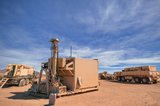
The US Army demonstrated an unclassified battalion-sized wireless command post during the Network Integration Evaluation (NIE) 15.2 in May. It will demonstrate an unclassified brigade-sized wireless main command post during NIE 16.1.
The wireless command post is expected to be fielded to army units that are part of the Warfighter Information Network-Tactical (WIN-T), Increment 1 network. Without wireless capability, a typical brigade command post requires 1,000ft of CAT 5 cable to be cut, laid out, configured and plugged in. According to the army, a wireless capability can reduce the network setup and teardown time from several hours to minutes.
In addition, command posts without Wi-Fi capability need to be set up in phases, with network servers, generators and tent infrastructure set up first, after which the cables are run through the post.
Lt Col Joel Babbitt, product manager, WIN-T Increment 1, said: ‘Now, right after the tents go up, units can turn on the Wi-Fi ‘hotspot’ and bam! They have a LAN. So instead of your network coming up last, now it comes up first. Meaning that instead of network communications being restored several hours after jumping to a new location, a unit has it within the first hour after arriving. That’s enabling manoeuvre. Wireless reduces a unit’s most vulnerable time period.’
With wireless capability, the army can also save up on air cargo and truck cargo space otherwise reserved for raised flooring to accommodate the command post cables. Additionally, it enables the use of voice-over internet protocol for communications.
The biggest challenge to wireless capabilities is information security. The army, however, added a low-cost solution similar to the security software used in online shopping.
Maj Ken Selby, 1-35 battalion operations officer, said: ‘For expeditionary purposes, a wireless command post definitely fits in with the army’s model of trying to make the [tactical operations centre] more mobile and scalable, to get the TOC from one position to the next and set up quickly.’