US approves sale of 66 F-16 fighters to Taiwan


The US State Department on 20 August approved the sale of 66 F-16 fighters to Taiwan, in a move expected to anger Beijing.
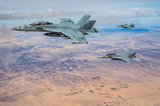
Taiwan will get the latest version of the Lockheed Martin-built fighter, the F-16C/D Block 70, in the $8 billion deal, the State Department said.
Secretary of State Mike Pompeo said in a statement that President Donald Trump had green-lighted the proposed sale after Congress was notified last week.
The F-16s ‘are deeply consistent with the arrangements, the historical relationship between the United States and China,’ Pompeo said. ‘Our actions are consistent with past US policy. We are simply following through on the commitments we’ve made to all of the parties.’
Taiwan’s plan to upgrade its air defences comes amid increasing Chinese military incursions into its air space.
A spokesman for the Taiwanese president released a statement saying the jets would ‘substantially enhance our air defence capabilities to help Taiwan’s self-defence and maintain the people’s freedom and welfare.’
The sale’s approval will have a key role in ‘peace and stability in the Taiwan Strait and region, especially in the wake of China’s frequent military actions... in the region in recent years,’ the statement said.
Beijing regards Taiwan as a part of China awaiting reunification, but the island is self-ruled and is a close ally of the United States.
In a statement, the Defense Security Cooperation Agency, which oversees US foreign military sales, said Taiwan’s purchase of the F-16s ‘will not alter the basic military balance in the region.’
‘This proposed sale will contribute to the recipient’s capability to provide for the defence of its airspace, regional security, and interoperability with the United States.’
On Monday, China’s foreign ministry spokesperson Geng Shuang said US arms sales to Taiwan ‘severely violate’ agreements between Washington and Beijing and ‘constitute severe interference in China’s internal affairs.’
The United States should ‘immediately cancel the planned arms sales, and stop selling weapons and military contact with Taiwan,’ he said. ‘Otherwise, the US will have to bear all the consequences.’
Taiwan already has a fleet of old-model F-16s purchased in 1992, which have undergone several crucial upgrades.
Manufacturer Lockheed Martin says the newest version, the F-16 Block 70/72, includes many avionics, weapons and radar technologies not in existence when earlier models were created.
It is structurally stronger, the company says, so that it ‘can fly and fight to 2070 and beyond.’
The approval of the sale comes as Washington and Beijing face off in tough trade negotiations that economists say are hurting both of the superpowers, as well as dragging down the global economy.



More from Defence Notes
-
![Orchestrating operational readiness across every defence domain]()
Orchestrating operational readiness across every defence domain
Are all systems ready for the next mission? Have upgrades been applied? Are all assets aligned to deploy together, on time and fully prepared? In modern defence operations, readiness is no longer measured platform by platform. It is measured by how well people, assets, data and decisions move together — across land, sea and air.
-
![How deepening AI usage can boost efficiency and maximise effects for forces]()
How deepening AI usage can boost efficiency and maximise effects for forces
Saab has outlined how it is using artificial intelligence to make training more like electronic gaming, while the UK’s Power Size Technologies is applying the same technology to better evaluate and design vehicle capability, moving AI-enabled innovation further upstream from the frontline.
-
![From systems integrator to multi-domain solutions provider (video)]()
From systems integrator to multi-domain solutions provider (video)
Philipp von Brandenstein, Head of Corporate Communications at Rheinmetall, explains how Eurosatory 2026 marked a new stage in the company's evolution.
-
![US Pentagon pushes for major reform of defence acquisition system]()
US Pentagon pushes for major reform of defence acquisition system
The US Department of Defense has requested new contracting authorities from Congress, using the Army's MV-75 Cheyenne programme to demonstrate how competition, digital engineering and closer industry collaboration could accelerate acquisitions.
-
![US speeds up B61-13 nuclear bomb production as programme moves further ahead of schedule]()
US speeds up B61-13 nuclear bomb production as programme moves further ahead of schedule
The US government plans to accelerate production even further after achieving key B61-13 milestones months ahead of schedule, as the programme advances amid growing US-China strategic competition.