UK doubles military support to Ukraine with £1 billion package
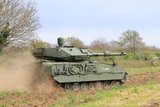
The AS90 self-propelled howitzer, seen here in Estonia, has been provided to Ukraine along with a range of other equipment. (Photo: Crown Copyright)
The UK has announced a further £1 billion ($1.2 billion) in military support to Ukraine, bringing the total value of aid since the start of the invasion to £2.3 billion.


UK Prime Minister Boris Johnson announced that the UK will provide another £1 billion of military support to Ukraine at the NATO Leaders Summit on 30 June. The support includes air defence systems, UAVs, EW equipment and thousands of pieces of individual kit for Ukrainian soldiers.
Aid provided so far includes: more than 5,000 NLAW antitank missiles; long-range Multiple Launch Rocket Systems (MLRS); artillery systems such as 155mm self-propelled guns; and rapid design and production of medium-range persistent loitering munitions.
UK Defence Secretary Ben Wallace had announced on 6 June that the UK would be sending the M270 MLRS to Ukraine and training is
Our news & analysis is now part of Defence Insight®
A Basic-level or higher Defence Insight subscription is now required to view this content.


More from Defence Notes
-
![UK urged to prioritise sea, air and space over heavy armour]()
UK urged to prioritise sea, air and space over heavy armour
A report from the Council on Geostrategy argues the UK should move away from a traditional balanced force and shift investment to naval, air and space capabilities, backed by a larger fleet of attack submarines and deeper AUKUS integration.
-
![Thales: deployment speed to determine winners in ‘production versus production’ era]()
Thales: deployment speed to determine winners in ‘production versus production’ era
At its technology summit in London, attended by Shephard, Thales UK examined the importance of speed to delivery, the growing focus on cross-domain capabilities and how procurement reform could be crucial for future battlefield advantage.
-
![Orchestrating operational readiness across every defence domain]()
Orchestrating operational readiness across every defence domain
Are all systems ready for the next mission? Have upgrades been applied? Are all assets aligned to deploy together, on time and fully prepared? In modern defence operations, readiness is no longer measured platform by platform. It is measured by how well people, assets, data and decisions move together — across land, sea and air.
-
![Global tensions drive defence supply chain scrutiny]()
Global tensions drive defence supply chain scrutiny
Governments worldwide are scrambling to decouple defence supply chains from dependency upon strategic rivals, but countries could struggle to do it all themselves.
-
![How deepening AI usage can boost efficiency and maximise effects for forces]()
How deepening AI usage can boost efficiency and maximise effects for forces
Saab has outlined how it is using artificial intelligence to make training more like electronic gaming, while the UK’s Power Size Technologies is applying the same technology to better evaluate and design vehicle capability, moving AI-enabled innovation further upstream from the frontline.
-
![From systems integrator to multi-domain solutions provider (video)]()
From systems integrator to multi-domain solutions provider (video)
Philipp von Brandenstein, Head of Corporate Communications at Rheinmetall, explains how Eurosatory 2026 marked a new stage in the company's evolution.