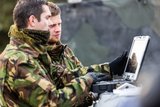
Serbia president says army being ‘dramatically strengthened’


Serbian President Aleksandar Vucic on 10 November said the country’s army was being ‘dramatically’ strengthened.
Vucic was speaking as he attended a major military exercise to mark the end of World War I and after Kosovo President Hashim Thaci said in an interview with AFP on 9 October that Pristina was sticking to its recent decision to create its own army.
That decision has provoked anger from Kosovo’s own ethnic Serb minority as well as from Stnxerbia.
NATO, which leads a military force that ensures Kosovo’s security, has also expressed serious reservations.
Vucic told the state-run RTS television 10 November that his country’s army was among the strongest in the region with exception of Romania.
‘Us (Serbia) and the Hungarians are similar, but all the others are far, far behind. We are dramatically strengthening our army,’ said Vucic after attending the exercise in Serbia’s east.
‘We will have to arm ourselves in line with new technologies, we already ordered from our Chinese friends (our) first armed drones. People will see that in 2019.’
About 8,000 soldiers, 100 tanks and eight MiG-29 jets participated in the ‘Century of Winners’ exercise, local media reported.
Vucic and Thaci had a meeting 8 November in Brussels to relaunch dialogue on the normalisation of ties between the former foes. Kosovo declared independence from Serbia in 2008.
The move came a decade after the 1998-1999 war between Belgrade forces and pro-independence ethnic Albanian guerrillas.
Serbia - and its main ally Russia and its main ally Russia - refuse to recognise Kosovo’s independence, although more than 100 countries, including the United States and most European Union member states, have done so.

More from Defence Notes
-
![Orchestrating operational readiness across every defence domain]()
Orchestrating operational readiness across every defence domain
Are all systems ready for the next mission? Have upgrades been applied? Are all assets aligned to deploy together, on time and fully prepared? In modern defence operations, readiness is no longer measured platform by platform. It is measured by how well people, assets, data and decisions move together — across land, sea and air.
-
![How deepening AI usage can boost efficiency and maximise effects for forces]()
How deepening AI usage can boost efficiency and maximise effects for forces
Saab has outlined how it is using artificial intelligence to make training more like electronic gaming, while the UK’s Power Size Technologies is applying the same technology to better evaluate and design vehicle capability, moving AI-enabled innovation further upstream from the frontline.
-
![From systems integrator to multi-domain solutions provider (video)]()
From systems integrator to multi-domain solutions provider (video)
Philipp von Brandenstein, Head of Corporate Communications at Rheinmetall, explains how Eurosatory 2026 marked a new stage in the company's evolution.
-
![US Pentagon pushes for major reform of defence acquisition system]()
US Pentagon pushes for major reform of defence acquisition system
The US Department of Defense has requested new contracting authorities from Congress, using the Army's MV-75 Cheyenne programme to demonstrate how competition, digital engineering and closer industry collaboration could accelerate acquisitions.