Raytheon subsidiary showcases inter-satellite communication
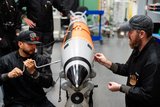
This was a demonstration not only of optical communications in space but also a closer look at some of the foundational building blocks needed for a networked space architecture. (Image: Raytheon)
Raytheon’s subsidiary, SEAKR Engineering, has demonstrated the ability for data transfer between two satellites in orbit.


SEAKR Engineering, a subsidiary of Raytheon Technologies, announced a successful demonstration of optical inter-satellite links between two Defense Advanced Research Projects Agency Mandrake 2 satellites.
During the first test, more than 280GB of data were transferred at a range of 11km during a period of more than 40min.
Under DARPA’s Blackjack project, two Mandrake 2 spacecraft were launched last year to demonstrate advanced laser communications.
The satellites, called Able and Baker, were outfitted with SA Phototronics optical links onboard an Astro Digital bus.
ASI provided the satellite software needed to operate the vehicles, while SEAKR, the prime contractor, led the system integration of both satellites.
Originally scheduled for a January 2021 launch, a pre-launch accident damaged both Able and Baker satellites. SAEKR was able to repair and rebuild the satellites and then deliver them for launch in less than six months.
These demonstrations are the foundation for DARPA’s Pitboss and future Battle Management Command Control and Communication systems.

You may also like

More from Defence Notes
-
![From systems integrator to multi-domain solutions provider (video)]()
From systems integrator to multi-domain solutions provider (video)
Philipp von Brandenstein, Head of Corporate Communications at Rheinmetall, explains how Eurosatory 2026 marked a new stage in the company's evolution.
-
![US Pentagon pushes for major reform of defence acquisition system]()
US Pentagon pushes for major reform of defence acquisition system
The US Department of Defense has requested new contracting authorities from Congress, using the Army's MV-75 Cheyenne programme to demonstrate how competition, digital engineering and closer industry collaboration could accelerate acquisitions.
-
![US speeds up B61-13 nuclear bomb production as programme moves further ahead of schedule]()
US speeds up B61-13 nuclear bomb production as programme moves further ahead of schedule
The US government plans to accelerate production even further after achieving key B61-13 milestones months ahead of schedule, as the programme advances amid growing US-China strategic competition.
-
![Canada’s C$2 billion ACSV deal reinforces new defence industrial strategy as allies align]()
Canada’s C$2 billion ACSV deal reinforces new defence industrial strategy as allies align
General Dynamics Land Systems-Canada is the country’s first strategic partner under the Defence Industrial Strategy’s Strategic Partnership Framework, an effort to provide companies with confidence to invest and boost the defence labour force.
-
![New UK armed forces minister frames High North defence as vital to “homeland security”]()
New UK armed forces minister frames High North defence as vital to “homeland security”
The UK’s Minister for the Armed Forces Louise Sandher-Jones made her first appearance in the role before the House of Commons Defence Committee this week to highlight efforts to improve capability in the High North.
-
![Canada seeks to strengthen industrial ties with the US on classified programmes]()
Canada seeks to strengthen industrial ties with the US on classified programmes
Ottawa explores expanding defence-industrial cooperation with Washington into sensitive programmes, an approach that could reshape NORAD modernisation, strengthen North American supply chains and create new opportunities for defence contractors.