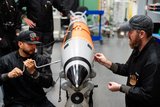
AIM-9X fired from MML
Raytheon and the US Army have successfully test fired an AIM-9X Block II missile from the Indirect Fire Protection Capability Increment 2-I (IFPC 2-I) Block 1 ground-based Multi-Mission Launcher (MML), the company announced on 26 August.
The AIM-9X missile is typically fired from an aircraft against aerial targets, but this successful demonstration showed that the Block II version can be used in ground-based air defence without any modification.
During the demonstration, the missile locked onto an unmanned aerial system (UAS) flying at an altitude of 1,500m above ground level, which it then intercepted and destroyed.
The test validated the design and operation of the prototype IFPC 2-I MML and demonstrated the surface launch performance of the missile against a UAS target.
Mike Jarrett, vice president, Raytheon Air Warfare Systems, said: ‘This is another example of how Raytheon is leveraging its proven portfolio of products to fulfil gaps in other mission areas, such as ground-based air defence. AIM-9X can perform well against fighter aircraft, unmanned aerial systems or cruise missiles and retain the ‘first look, first shot, first kill’ reputation – in the air and from the ground.’
The AIM-9X missile has been in service since 2003, with the Block II missile completing its operational test and evaluation in early 2015. In March, the US Navy declared initial operational capability with the Block II.
Related Equipment in Defence Insight



You may also like

More from Defence Notes
-
![From systems integrator to multi-domain solutions provider (video)]()
From systems integrator to multi-domain solutions provider (video)
Philipp von Brandenstein, Head of Corporate Communications at Rheinmetall, explains how Eurosatory 2026 marked a new stage in the company's evolution.
-
![US Pentagon pushes for major reform of defence acquisition system]()
US Pentagon pushes for major reform of defence acquisition system
The US Department of Defense has requested new contracting authorities from Congress, using the Army's MV-75 Cheyenne programme to demonstrate how competition, digital engineering and closer industry collaboration could accelerate acquisitions.
-
![US speeds up B61-13 nuclear bomb production as programme moves further ahead of schedule]()
US speeds up B61-13 nuclear bomb production as programme moves further ahead of schedule
The US government plans to accelerate production even further after achieving key B61-13 milestones months ahead of schedule, as the programme advances amid growing US-China strategic competition.
-
![Canada’s C$2 billion ACSV deal reinforces new defence industrial strategy as allies align]()
Canada’s C$2 billion ACSV deal reinforces new defence industrial strategy as allies align
General Dynamics Land Systems-Canada is the country’s first strategic partner under the Defence Industrial Strategy’s Strategic Partnership Framework, an effort to provide companies with confidence to invest and boost the defence labour force.
-
![New UK armed forces minister frames High North defence as vital to “homeland security”]()
New UK armed forces minister frames High North defence as vital to “homeland security”
The UK’s Minister for the Armed Forces Louise Sandher-Jones made her first appearance in the role before the House of Commons Defence Committee this week to highlight efforts to improve capability in the High North.
-
![Canada seeks to strengthen industrial ties with the US on classified programmes]()
Canada seeks to strengthen industrial ties with the US on classified programmes
Ottawa explores expanding defence-industrial cooperation with Washington into sensitive programmes, an approach that could reshape NORAD modernisation, strengthen North American supply chains and create new opportunities for defence contractors.