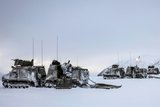
Moscow slams Norway plans to double US troop presence


Moscow on 14 June criticised Norway’s plans to ask Washington to double the number of US troops stationed in the Scandinavian country and deploy them nearer the border with Russia.
The plans ‘cause us serious concern,’ Russia’s embassy in Norway wrote on its Facebook page.
Before joining NATO in 1949, Norway allayed Russian fears by pledging not to open its territory to foreign combat troops so long as it was not attacked or threatened with attack.
The stationing of US troops in Norway ‘contravenes the Norwegian decision from 1949... This makes Norway less predictable, can stoke tensions, incite an arms race and lead to a destabilisation of the situation in northern Europe,’ the embassy wrote.
Oslo’s announcement came after nine nations along NATO’s eastern flank recently called for the alliance to bolster its presence in their region.
Since 2017, 330 US Marines have been deployed on rotation at Vaernes in the centre of Norway, despite loud protests from Russia.
Oslo now wants to boost the troop numbers to 700 and station them further north at Setermoen, 420kms from Russia.
The US deployment agreement would also be extended from the current six-month renewable periods to five years.
Frank Bakke-Jensen, Norwegian Minister of Defence, said in a statement: ‘The defence of Norway depends on the support of our NATO allies, as is the case in most other NATO countries. For this support to work in times of crises and war, we are totally dependent on joint training and exercises in times of peace.’
Bulgaria, Czech Republic, Estonia, Hungary, Latvia, Lithuania, Poland, Romania and Slovakia had on 8 June called for NATO to discuss an increased military presence in their region at the leaders’ summit in Brussels in July 2018.
The group said it was necessary to supplement NATO’s current ground forces ‘with aerial and naval components.’
NATO beefed up defences in central and eastern Europe in response to growing fears about Russia, following Moscow’s annexation of Crimea in 2014.
Norway has insisted that it is respecting its 1949 commitment, noting that the troop presence is not permanent but rotational.
But Moscow rejected that argument.
It said: ‘Even if the actual people are rotated, the stationing is continuous.’
Russia also expressed ‘concern’ that the ‘plans were agreed in Oslo without any real bilateral political dialogue.’




More from Defence Notes
-
![US speeds up B61-13 nuclear bomb production as programme moves further ahead of schedule]()
US speeds up B61-13 nuclear bomb production as programme moves further ahead of schedule
The US government plans to accelerate production even further after achieving key B61-13 milestones months ahead of schedule, as the programme advances amid growing US-China strategic competition.
-
![Canada’s C$2 billion ACSV deal reinforces new defence industrial strategy as allies align]()
Canada’s C$2 billion ACSV deal reinforces new defence industrial strategy as allies align
General Dynamics Land Systems-Canada is the country’s first strategic partner under the Defence Industrial Strategy’s Strategic Partnership Framework, an effort to provide companies with confidence to invest and boost the defence labour force.
-
![New UK armed forces minister frames High North defence as vital to “homeland security”]()
New UK armed forces minister frames High North defence as vital to “homeland security”
The UK’s Minister for the Armed Forces Louise Sandher-Jones made her first appearance in the role before the House of Commons Defence Committee this week to highlight efforts to improve capability in the High North.
-
![Canada seeks to strengthen industrial ties with the US on classified programmes]()
Canada seeks to strengthen industrial ties with the US on classified programmes
Ottawa explores expanding defence-industrial cooperation with Washington into sensitive programmes, an approach that could reshape NORAD modernisation, strengthen North American supply chains and create new opportunities for defence contractors.