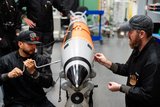
IAI issues another call to start-ups


The Innovation Center of Israel Aerospace Industries (IAI) on 16 August issued a call for start-ups to apply for its next 13-week accelerator programme, which begins on 1 November.
The company said the programme offers a ‘first-of-its-kind hybrid working model’ with leading IAI technology experts, enabling start-up companies to co-create proof-of-concept solutions.
Start-ups admitted to the programme benefit from knowledge sharing, a range of infrastructure, technological support, and a business-oriented enrichment programme.
Participants will also be acquainted with IAI extensive marketing activities and customers.
The programme is open to start-ups specialising in disciplines such as machine learning; quantum computing; radar; robotics; big data; computer vision; smart cockpits; UAVs; cyber; novel energy sources; and the Internet of Things.
As part of our promise to deliver comprehensive coverage to our Defence Insight and Premium News subscribers, our curated defence news content provides the latest industry updates, contract awards and programme milestones.




More from Defence Notes
-
![Orchestrating operational readiness across every defence domain]()
Orchestrating operational readiness across every defence domain
Are all systems ready for the next mission? Have upgrades been applied? Are all assets aligned to deploy together, on time and fully prepared? In modern defence operations, readiness is no longer measured platform by platform. It is measured by how well people, assets, data and decisions move together — across land, sea and air.
-
![How deepening AI usage can boost efficiency and maximise effects for forces]()
How deepening AI usage can boost efficiency and maximise effects for forces
Saab has outlined how it is using artificial intelligence to make training more like electronic gaming, while the UK’s Power Size Technologies is applying the same technology to better evaluate and design vehicle capability, moving AI-enabled innovation further upstream from the frontline.
-
![From systems integrator to multi-domain solutions provider (video)]()
From systems integrator to multi-domain solutions provider (video)
Philipp von Brandenstein, Head of Corporate Communications at Rheinmetall, explains how Eurosatory 2026 marked a new stage in the company's evolution.
-
![US Pentagon pushes for major reform of defence acquisition system]()
US Pentagon pushes for major reform of defence acquisition system
The US Department of Defense has requested new contracting authorities from Congress, using the Army's MV-75 Cheyenne programme to demonstrate how competition, digital engineering and closer industry collaboration could accelerate acquisitions.
-
![US speeds up B61-13 nuclear bomb production as programme moves further ahead of schedule]()
US speeds up B61-13 nuclear bomb production as programme moves further ahead of schedule
The US government plans to accelerate production even further after achieving key B61-13 milestones months ahead of schedule, as the programme advances amid growing US-China strategic competition.