IAI and KAI to jointly develop loitering munitions
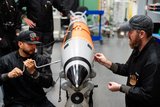
HARPY is an all-weather day/night "Fire and Forget" autonomous weapon, launched from a ground vehicle behind the battle zone. (Photo: Israel Aerospace Industries)
This week, at ADEX 2021, IAI and KAI have signed an MoU for the development of a loitering munition


Israeli Aerospace Industries (IAI) and Korea Aerospace Industries (KAI) have signed a memorandum of understanding on a loitering munitions programme.
The MoU seeks to secure a new concept weapons system that will maximise the effectiveness of suppression and destruction of enemy air defences missions.
Cooperation between IAI and KAI will offer the South Korean military new technologies and will establish concrete cooperation plans through joint feasibility studies.
IAI will benefit from a closer relationship with the Koran manufacturer and will bring its expertise as a global leader in developing loitering munition systems.
The new concept weapon system will be able to perform long-endurance reconnaissance missions and can strike a target immediately when necessary.
This is, at least, the second MoU the companies have signed together this year.
In March 2021, the companies signed a collaborative agreement on the development of loitering munitions, with particular attention on crewed-uncrewed teaming.
The Harpy is one of IAI’s flagship (or rather drone) loitering munition products.
According to Shephard Defence Insight, the Harpy NG is stored, transported, deployed and launched from a canister mounted on a ground-based launcher which can be mounted on both naval or land-based vehicles.
Related Equipment in Defence Insight

You may also like


More from Defence Notes
-
![From systems integrator to multi-domain solutions provider (video)]()
From systems integrator to multi-domain solutions provider (video)
Philipp von Brandenstein, Head of Corporate Communications at Rheinmetall, explains how Eurosatory 2026 marked a new stage in the company's evolution.
-
![US speeds up B61-13 nuclear bomb production as programme moves further ahead of schedule]()
US speeds up B61-13 nuclear bomb production as programme moves further ahead of schedule
The US government plans to accelerate production even further after achieving key B61-13 milestones months ahead of schedule, as the programme advances amid growing US-China strategic competition.
-
![Canada’s C$2 billion ACSV deal reinforces new defence industrial strategy as allies align]()
Canada’s C$2 billion ACSV deal reinforces new defence industrial strategy as allies align
General Dynamics Land Systems-Canada is the country’s first strategic partner under the Defence Industrial Strategy’s Strategic Partnership Framework, an effort to provide companies with confidence to invest and boost the defence labour force.
-
![New UK armed forces minister frames High North defence as vital to “homeland security”]()
New UK armed forces minister frames High North defence as vital to “homeland security”
The UK’s Minister for the Armed Forces Louise Sandher-Jones made her first appearance in the role before the House of Commons Defence Committee this week to highlight efforts to improve capability in the High North.
-
![Canada seeks to strengthen industrial ties with the US on classified programmes]()
Canada seeks to strengthen industrial ties with the US on classified programmes
Ottawa explores expanding defence-industrial cooperation with Washington into sensitive programmes, an approach that could reshape NORAD modernisation, strengthen North American supply chains and create new opportunities for defence contractors.