Global tensions drive defence supply chain scrutiny
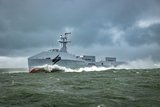
The UK Royal Navy Kraken K3 Scout USV was found to contain location-tracking firmware made in China. (Photo: Royal Navy/Crown Copyright)
Governments worldwide are scrambling to decouple defence supply chains from dependency upon strategic rivals, but countries could struggle to do it all themselves.


From 1 October 2026, China will begin surveying its defence supply chains under a revised National Defense Mobilization Law to ensure they remain secure, and will push officials to take measures to improve defence self-reliance.
The new law, which was passed on 28 August, means Beijing joins a growing number of countries mapping supply dependencies in their defence sectors, amid a growing movement towards more self-reliance in many capitals. These include China’s main competitors in Western countries, where concerns about reliance on China-based suppliers were put under the spotlight this year after Beijing imposed export controls on multiple Japanese firms that it claimed supplied
Our news & analysis is now part of Defence Insight®
A Basic-level or higher Defence Insight subscription is now required to view this content.



More from Defence Notes
-
![“Engage with the operational problem”: how software innovation can boost UK defence]()
“Engage with the operational problem”: how software innovation can boost UK defence
In Conversation… Shephard’s Andrew White talks to Zafer Şen, CEO and co-founder of OBSS, about the future of command-and-control software in the age of artificial intelligence, and his company’s ambitions in the UK defence market.
-
![“Capital follows confidence” as defence courts private money]()
“Capital follows confidence” as defence courts private money
Outside investment and the direction in which venture money flows may reveal what defence will buy years before formal programmes begin.
-
![Canada’s new military drone marketplace targets rapid acquisition pipeline]()
Canada’s new military drone marketplace targets rapid acquisition pipeline
The Department of National Defence expects initial contracts to deliver thousands of uncrewed systems, but has yet to establish the quantities, capability mix or deadline behind Ottawa’s promised tenfold expansion.
-
![Ukraine turns legacy Kongsberg land turrets into semi-autonomous USV weapons]()
Ukraine turns legacy Kongsberg land turrets into semi-autonomous USV weapons
The company told Shephard that Ukraine is operating modified Protector weapon stations originally supplied for armoured vehicles, with human operators authorising engagements from hundreds of kilometres away.
-
![UK urged to prioritise sea, air and space over heavy armour]()
UK urged to prioritise sea, air and space over heavy armour
A report from the Council on Geostrategy argues the UK should move away from a traditional balanced force and shift investment to naval, air and space capabilities, backed by a larger fleet of attack submarines and deeper AUKUS integration.