With eye on China, Japan unveils record defence budget


Japan’s defence budget will swell to a record $47 billion for the next fiscal year, the government said Friday, as Tokyo beefs up its missile defence and deploys stealth jets in a bid to counter China.
The defence spending was part of a $912-billion national budget for the fiscal year starting in April 2019, approved by Prime Minister Shinzo Abe’s cabinet.
The government decided to set aside 5.26 trillion yen ($47 billion) for defence, the fifth record year in a row, defence ministry officials said.
The defence funding will cover the cost of introducing the US military’s Aegis Ashore land-based missile interceptor system, the officials said.
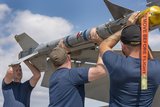
The FY 2019 allocation covers six F-35A stealth jets, and part of it will be spent on Japan’s first aircraft carriers since World War II.
The budget is the initial allocation of Japan’s new five-year defence plan, announced on Tuesday as the latest in a series of steps under Abe to boost the nation’s military.
Under the multi-year programme through March 2024, Japan will upgrade two existing helicopter carriers so that they can launch fighters.
Abe’s government argues the efforts are necessary given growing defence challenges in the region, including tensions with North Korea, and particularly ‘strong concerns’ about the expansion of China’s military footprint.
But the move is controversial, with critics arguing it shifts Tokyo further away from its commitment to strictly defensive capabilities under Japan’s post-WWII pacifist constitution.
Beijing immediately expressed its ‘strong dissatisfaction and opposition’ to the programme unveiled on Tuesday, urging Tokyo ‘to adhere to a purely defensive policy’.
Last year, China unveiled its first domestically built aircraft carrier as it continues to assert claims in the South China Sea. Beijing’s first carrier, the Liaoning, is a second-hand Soviet ship built nearly 30 years ago and commissioned in 2012.
Japan’s new programme comes after pledges to buy more US military equipment, under pressure from President Donald Trump.
The US leader has repeatedly complained about Washington’s huge trade deficit with Tokyo and also urged Abe to expand the country’s defensive capacity.
For his part, Abe has campaigned for years to amend Japan’s pacifist constitution, arguing that it ties the hands of the country’s Self-Defense Forces (SDF) even in protecting the country’s allies from attack.
‘Japan’s growing defence budget is directly aimed to counter China’s military threat,’ said Akira Kato, professor of international politics and regional security at Tokyo’s J.F. Oberlin University.
‘The budget gain is also part of Japan’s efforts to buy more US military equipment so that it can avoid a trade war with Washington,’ Kato told AFP, adding that Tokyo’s defence budget is expected to continue expanding.

You may also like

More from Defence Notes
-
![US Pentagon pushes for major reform of defence acquisition system]()
US Pentagon pushes for major reform of defence acquisition system
The US Department of Defense has requested new contracting authorities from Congress, using the Army's MV-75 Cheyenne programme to demonstrate how competition, digital engineering and closer industry collaboration could accelerate acquisitions.
-
![US speeds up B61-13 nuclear bomb production as programme moves further ahead of schedule]()
US speeds up B61-13 nuclear bomb production as programme moves further ahead of schedule
The US government plans to accelerate production even further after achieving key B61-13 milestones months ahead of schedule, as the programme advances amid growing US-China strategic competition.
-
![Canada’s C$2 billion ACSV deal reinforces new defence industrial strategy as allies align]()
Canada’s C$2 billion ACSV deal reinforces new defence industrial strategy as allies align
General Dynamics Land Systems-Canada is the country’s first strategic partner under the Defence Industrial Strategy’s Strategic Partnership Framework, an effort to provide companies with confidence to invest and boost the defence labour force.
-
![New UK armed forces minister frames High North defence as vital to “homeland security”]()
New UK armed forces minister frames High North defence as vital to “homeland security”
The UK’s Minister for the Armed Forces Louise Sandher-Jones made her first appearance in the role before the House of Commons Defence Committee this week to highlight efforts to improve capability in the High North.
-
![Canada seeks to strengthen industrial ties with the US on classified programmes]()
Canada seeks to strengthen industrial ties with the US on classified programmes
Ottawa explores expanding defence-industrial cooperation with Washington into sensitive programmes, an approach that could reshape NORAD modernisation, strengthen North American supply chains and create new opportunities for defence contractors.