US Navy extends Sarcos Guardian testing
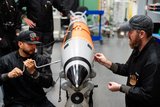
The Guardian DX performs intricate and dangerous tasks that require human-like skill, while keeping the operator at a safe distance. (Image: Sarcos)
Following a successful first phase of the Guardian DX contract, the US Navy has extended the testing of the platform.


The USN has exercised a contract option to expand the testing, evaluation and demonstrations of Sarcos Defense’s Guardian DX teleoperated dextrous robotic system.
The extended testing will focus on navy-specific tasks, with particular attention on the Navy’s maintenance modernisation and sustainment requirements.
The Guardian DX robot is the defence-specific variant of the Guardian XT highly dexterous mobile robotic system, which itself is a variant of the Guardian XO full-body, battery-powered industrial exoskeleton.
The Guardian DX robot is a teleoperated, dual-armed dexterous robot designed to perform tasks with human-like dexterity while keeping the operator at a safe distance in challenging and hazardous conditions.
Its modular design enables the robot to be mounted to a variety of mobile bases.
Sarcos Robotics was awarded a contract from the USAF in 2017 to develop a full-body exoskeleton for logistics applications.
The Guardian DX draws on this development and Sarcos’ experience developing UGVs, such as the company’s Guardian S UGV, which resembles a snake.

You may also like

More from Defence Notes
-
![From systems integrator to multi-domain solutions provider (video)]()
From systems integrator to multi-domain solutions provider (video)
Philipp von Brandenstein, Head of Corporate Communications at Rheinmetall, explains how Eurosatory 2026 marked a new stage in the company's evolution.
-
![US Pentagon pushes for major reform of defence acquisition system]()
US Pentagon pushes for major reform of defence acquisition system
The US Department of Defense has requested new contracting authorities from Congress, using the Army's MV-75 Cheyenne programme to demonstrate how competition, digital engineering and closer industry collaboration could accelerate acquisitions.
-
![US speeds up B61-13 nuclear bomb production as programme moves further ahead of schedule]()
US speeds up B61-13 nuclear bomb production as programme moves further ahead of schedule
The US government plans to accelerate production even further after achieving key B61-13 milestones months ahead of schedule, as the programme advances amid growing US-China strategic competition.
-
![Canada’s C$2 billion ACSV deal reinforces new defence industrial strategy as allies align]()
Canada’s C$2 billion ACSV deal reinforces new defence industrial strategy as allies align
General Dynamics Land Systems-Canada is the country’s first strategic partner under the Defence Industrial Strategy’s Strategic Partnership Framework, an effort to provide companies with confidence to invest and boost the defence labour force.
-
![New UK armed forces minister frames High North defence as vital to “homeland security”]()
New UK armed forces minister frames High North defence as vital to “homeland security”
The UK’s Minister for the Armed Forces Louise Sandher-Jones made her first appearance in the role before the House of Commons Defence Committee this week to highlight efforts to improve capability in the High North.
-
![Canada seeks to strengthen industrial ties with the US on classified programmes]()
Canada seeks to strengthen industrial ties with the US on classified programmes
Ottawa explores expanding defence-industrial cooperation with Washington into sensitive programmes, an approach that could reshape NORAD modernisation, strengthen North American supply chains and create new opportunities for defence contractors.