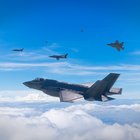
Updated US Air Force doctrine emphasises the need for multi-domain capabilities
An airman in an airdrop and static-line jump training. (Photo: US Air Force)
Modifications in the US Air Force (USAF) doctrine aim to prepare the service for tomorrow’s warfare.


The USAF recently released updates to its doctrine for operations, command and control (C2) and planning, which focused on capabilities for multi-domain deployments. The modifications are intended to create a more lethal, resilient force and prepare personnel, structures and equipment for tomorrow’s warfare.
Gen David Allvin, the service’s Chief of Staff, stated in a memo that the changes will prepare the branch to reach “the next level of effectiveness”.
“In this era of rapid change, air force doctrine is adapting to ensure we are one air force, ready to employ airpower to deter, and if required, prevail in
Our news & analysis is now part of Defence Insight®
A Basic-level or higher Defence Insight subscription is now required to view this content.

You may also like
More from Air Warfare
-
![Propulsion for the autonomous era]()
Propulsion for the autonomous era
For decades, advanced military propulsion has centred on enabling ever-more capable fighters and bombers – delivering more thrust, more range, greater power, and thermal management, plus longer service lives. Those requirements remain essential. However, the rise of autonomous systems, advanced effectors, and autonomous collaborative platforms is redefining what that propulsion must deliver.
-
![Czech Republic UAV focus: moderate market value masks limited supplier opportunities]()
Czech Republic UAV focus: moderate market value masks limited supplier opportunities
The Czech Republic’s shift towards smaller uncrewed aerial vehicles has reshaped its procurement priorities, leaving nearly three-quarters of the market unawarded. Yet with this value concentrated in just two programmes, the highest-value opportunities could contain a high level of risk.
-
![RAF Protector fleet grows as UK maritime surveillance role takes shape]()
RAF Protector fleet grows as UK maritime surveillance role takes shape
The RAF’s expanding Protector RG1 fleet could play a growing role in UK maritime surveillance following its first domestic operational sorties, with further aircraft deliveries scheduled through 2027.
-
![Leonardo details Proteus’s path to autonomous anti-submarine missions for the Royal Navy]()
Leonardo details Proteus’s path to autonomous anti-submarine missions for the Royal Navy
Leonardo’s integration of Shield AI’s Hivemind software could enable its Proteus uncrewed helicopter to conduct independent anti-submarine warfare missions, supporting the Royal Navy’s plans for a future hybrid air wing.
-
![Oshkosh and Grid Aero tie-up tests new model for scaling military UAS production]()
Oshkosh and Grid Aero tie-up tests new model for scaling military UAS production
By combining established manufacturing capacity with startup aircraft design, the partnership could offer an alternative approach to scaling military uncrewed aircraft production.