Taiwan expands its UAV inventory to meet future threats
The Albatross II from NCSIST is designed for maritime surveillance and reconnaissance missions. (Photo: Charles Au)
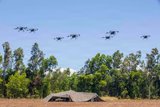
Taiwan is busy developing new types of UAVs to equip its armed forces.


Taiwan’s policy of developing autonomous systems has become more aggressive over the past two years, as evidenced by the National Chung-Shan Institute of Science and Technology (NCSIST) displaying five upgraded UAV platforms in Taichung this week.
One new UAV was the Albatross II, a larger version with a different appearance compared to the Albatross I. It will be tasked with maritime surveillance and reconnaissance missions thanks to its 300+km range and 16h endurance.
The Albatross II’s FLIR payload is mounted farther forward towards the nose, as the original belly position has been taken by what is believed to be
Our news & analysis is now part of Defence Insight®
A Basic-level or higher Defence Insight subscription is now required to view this content.



More from Air Warfare
-
![US military tests AI-powered CUAS turret against drone swarms]()
US military tests AI-powered CUAS turret against drone swarms
As the US continues to invest heavily in counter-drone systems, demand for low-cost, mobile and autonomous technologies is on the rise, with Edda designed to align with these emerging requirements.
-
![August crewed air review: KC-390 momentum builds as demand in the tanker market grows]()
August crewed air review: KC-390 momentum builds as demand in the tanker market grows
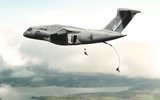
The KC-390 is building a growing international operator base, but competition in the transport and tanker market is increasingly likely to depend on interoperability, commonality and the strength of supporting ecosystems. Meanwhile, Boeing’s KC-46 and Airbus’s A330 also gained ground in August.
-
![Iran war exposes the limits of US military mass]()
Iran war exposes the limits of US military mass
As the Straits of Hormuz continue to witness military action of various types, what does this mean for combat air and air defence planners in the region and beyond?
-
![New E-3 and T-38 awards expose US Air Force legacy fleet dependence]()
New E-3 and T-38 awards expose US Air Force legacy fleet dependence
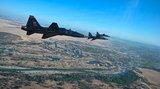
Contracts for E-3 aircrew training through August 2029 and supplies for the T-38 engine until December 2028 reflect issues with replacement and retirement plans across the USAF inventory.
-
![USMC advances MV-22B Osprey safety and reliability upgrades]()
USMC advances MV-22B Osprey safety and reliability upgrades
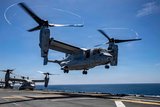
The US Marine Corps is testing a redesigned input quill assembly and plans to transition its MV-22B fleet to improved gearboxes by January 2033 as it prepares to operate the tiltrotor through 2055.