Shield AI successfully demonstrates autonomous teaming with V-BAT UAS
Shield AI has completed an autonomous teaming demonstration using three V-BAT UAS. (Photo: Shield AI)
Shield AI has completed an autonomous teaming demonstration using three V-BAT UAS, showcasing their Hivemind AI pilot and paving the way for deployable teaming capabilities in GPS-denied environments.


The demonstration was the final milestone of the innovation arm of the Department of the Air Force (AFWERX) autonomy effort under its Strategic Funding Increase programme and in collaboration with the Air Force Research Laboratory (AFRL) Sensors Directorate.
Shield AI used its Hivemind AI pilot to launch a team of three V-BATs to monitor and surveil simulated wildfires. The multi-agent, coordinated team conducted detect, identify, locate, and report (DILR) missions in a contingency scenario with dual-use applications.
This work with AFWERX sets Shield AI on a path to deploy V-BAT teaming capabilities in GPS- and- communications-denied environments in 2024.
Related Articles
Shield AI, Sentient Vision collaborate on AI-enabled wide-area imagery
Shield AI’s president Brandon Tseng said: ‘Intelligent, affordable mass that can see everything on the battlefield, execute the mission even when GPS and comms are denied or degraded, and put all our adversaries’ military assets at risk at all times is the Holy Grail of deterrence. This milestone brings us closer to achieving that reality.’
‘We had many customers from across the DoD enterprise attend the event and my favourite customer quote was “Wait, you’re flying those three aircraft, doing the recon, and at the same time briefing us?”’
Hivemind can be trained for a variety of missions and its modular open systems architecture enables portability to other aircraft. It has flown quadcopters, V-BATs and jet aircraft.
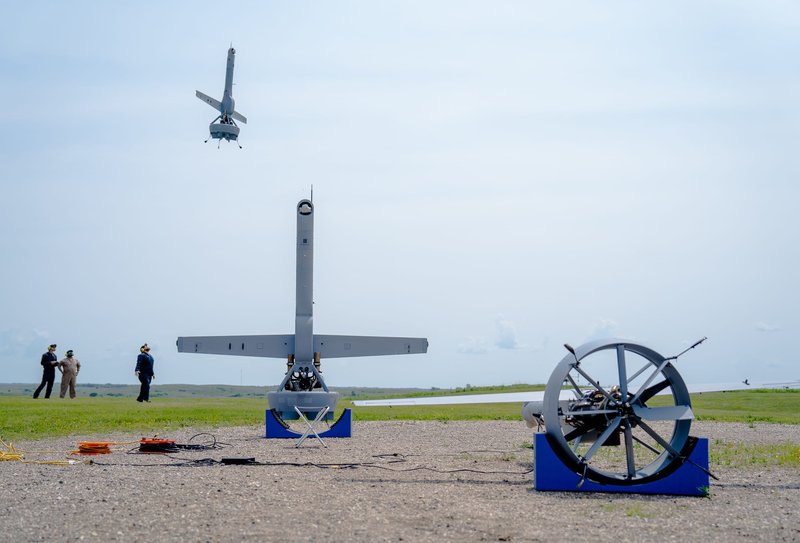
V-BAT teaming capabilities in GPS- and- communications-denied environments are expected to be deployed in 2024. (Photo: Shield AI)
According to the company Hivemind can be trained to undertake a range of missions, including integrated air defence breach, SCUD missile hunting, zone reconnaissance, counter-air, beyond-visual-range strike, maritime domain awareness and communications-contested operations.
AFWERX prime division chief Col Tom Meagher said: ‘What’s exciting to us is not just the capability that teaming V-BATs can bring to the table or how it’s on a great path for fielding with DoD partners, but how autonomy stacks can be leveraged across different aircraft and programmes.’
‘The continual application of autonomy from small systems, now V-BAT, and onto larger platforms provides paths for industry progression and autonomy maturation.’
Related Programmes in Defence Insight
Future Tactical UAS (FTUAS) (Increment 2) [US Army]
Related Equipment in Defence Insight


More from Air Warfare
-
![V-22 Osprey safety upgrade moves towards wider fleet installation under $35.5 million deal]()
V-22 Osprey safety upgrade moves towards wider fleet installation under $35.5 million deal
Bell Boeing will supply 73 additional ODSSHI kits as NAVAIR prepares to introduce predictive drive-system monitoring across US and Japanese V-22 fleets.
-
![India’s rotary-wing capability gap grows as IMRH programme delays persist]()
India’s rotary-wing capability gap grows as IMRH programme delays persist
With IMRH and DBMRH potentially years from service, India faces a widening rotary-wing capability gap that could drive further foreign purchases even as HAL and Safran build the foundations of an indigenous successor.
-
![AFA 2026: Swarm Aero eyes 2027 Gamera flight as Textron/Merlin reveal SkyCourier UX]()
AFA 2026: Swarm Aero eyes 2027 Gamera flight as Textron/Merlin reveal SkyCourier UX
Two new uncrewed aircraft concepts target very different US military requirements, from massed long-range strike to autonomous logistics. Shephard spoke with executives from Swarm Aero, Textron Aviation and Merlin Labs at this year's AFA Air, Space & Cyber conference to learn more about their capabilities.