Shield AI, Sentient Vision collaborate on AI-enabled wide-area imagery
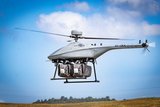
The V-BAT UAS will carry Sentient Vision Systems' ViDAR sensor. (Photo: USN)
Shield AI and Sentient Vision Systems will jointly develop a wide area motion imagery (WAMI) solution, integrating Sentient’s Visual Detection and Ranging (ViDAR) onto Shield AI’s V-BAT UAS.


Under the plan the companies will offer the system to the Australian DoD and US DoD as well as international customers through joint development and integration of ViDAR-enabled, wide-area-search capability onto Shield AI’s V-BAT unmanned aircraft. This will enable V-BAT to intelligently classify, track and read and react to targets in dynamic missions.
ViDAR is Sentient’s AI system, which uses an EO/IR sensor to detect and classify targets that would be invisible to a human operator or a conventional radar. With these enhanced capabilities in detection, V-BAT will offer a level of capability that significantly bolsters threat deterrence. It is planned to fly ViDAR on V-BAT in 2024.
ViDAR is already in use on UAVs, notably it has been deployed on Royal Australian Navy Insitu ScanEagles, and other platforms. The Kestrel ViDAR system is part of the sensor suite for the Australian Maritime Safety Authority’s Challenger 604 SAR jet aircraft.
Related Articles
Martin UAV announces launch of V-Bat 128
Enhanced V-Bat spreads its wings
Sentient has worked with Insitu since as far back as 2015 when, during a demonstration, the system detected objects including a fast boat over 9nmi away from the aircraft and a fishing vessel at 14nmi.
V-BAT 128 has been ordered by Canada and Brazil with deliveries to both countries believed to have begun. The V-BAT 118 is in the running to meet the US Army’s requirement to procure a Future Tactical UAS to replace the Textron Systems RQ-7Bv2 Shadow.
Related Equipment in Defence Insight



More from Air Warfare
-
![New US Army UH-60M Black Hawk order bridges uncertain path to MV-75 transition]()
New US Army UH-60M Black Hawk order bridges uncertain path to MV-75 transition
The US$234 million award for 16 Sikorsky UH-60Ms preserves near-term production, but funding uncertainty and an undefinitised contract leave the US Army’s long-term Black Hawk requirements unresolved.
-
![V-22 Osprey safety upgrade moves towards wider fleet installation under $35.5 million deal]()
V-22 Osprey safety upgrade moves towards wider fleet installation under $35.5 million deal
Bell Boeing will supply 73 additional ODSSHI kits as NAVAIR prepares to introduce predictive drive-system monitoring across US and Japanese V-22 fleets.
-
![AFA 2026: US Air Force examines uncrewed cargo aircraft for contested logistics]()
AFA 2026: US Air Force examines uncrewed cargo aircraft for contested logistics
The US Air Force is evaluating demonstrators for uncrewed cargo missions as it considers logistics requirements across the Pacific and other contested environments.
-
![Germany air focus: Europe’s leading near-term air market targets domestic industry]()
Germany air focus: Europe’s leading near-term air market targets domestic industry
Between 2026 and 2032, almost a quarter of EU aircraft spending is expected to come from Germany. While crewed programmes seek modernisation and replacement, uncrewed opportunities look to introduce entirely new capabilities, with both highlighting sovereignty and domestic production.
-
![Europe risks losing control of CUAS production capacity as manufacturers look abroad]()
Europe risks losing control of CUAS production capacity as manufacturers look abroad
European counter-drone developers are securing early orders in the Middle East while slow domestic acquisition processes threaten to redirect production capacity, expertise and investment away from Europe.