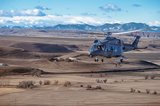
MRSAM draws closer for Indian Army
The MRSAM air defence missile moves closer to future service with a recent successful test firing.


The Medium-Range Surface-to-Air Missile (MRSAM) for the Indian Army was successfully tested late last year at the Chandipur Integrated Test Range, though some prerequisites remain to be established, Shephard has learned.
The $1.6 billion MRSAM contract was signed in mid-2017 as a technical joint development venture between Israel Aerospace Industries (IAI) and India’s Defence Research and Development Organisation (DRDO).
The collaborative project includes public- and private-sector Israeli and Indian companies, including Rafael, Tata, Bharat Electronics, Larsen & Toubro, Bharat Dynamics (BDL) and others.
Boaz Levy, IAI’s president and CEO, said: ‘Every trial in an air defence system is a complex
Our news & analysis is now part of Defence Insight®
A Basic-level or higher Defence Insight subscription is now required to view this content.


More from Air Warfare
-
![AFA 2026: Swarm Aero eyes 2027 Gamera flight as Textron/Merlin reveal SkyCourier UX]()
AFA 2026: Swarm Aero eyes 2027 Gamera flight as Textron/Merlin reveal SkyCourier UX
Two new uncrewed aircraft concepts target very different US military requirements, from massed long-range strike to autonomous logistics. Shephard spoke with executives from Swarm Aero, Textron Aviation and Merlin Labs at this year's AFA Air, Space and Cyber conference to learn more about their capabilities.
-
![US Navy moves EA-18G Growler Block II electronic-attack upgrade into full-rate production]()
US Navy moves EA-18G Growler Block II electronic-attack upgrade into full-rate production
A US$184.25 million contract for Next Generation Electronic Attack Units advances the Growler’s modernisation as the US Navy confronts ageing systems, parts shortages and obsolescence.
-
![Could the next UAS market boom take place beyond the battlefield?]()
Could the next UAS market boom take place beyond the battlefield?
While the headlines remain dominated by the use of drones for combat operations in Ukraine and other conflicts, there are emerging use cases where the technology could usefully feed back into areas and missions outside the war zone.
-
![USAF eyes sensor and weapon upgrades as MH-139A Grey Wolf achieves IOC]()
USAF eyes sensor and weapon upgrades as MH-139A Grey Wolf achieves IOC
The Grey Wolf has entered operational service nearly three years later than originally planned, while new sustainment contracts indicate that some UH-1Ns could remain supported until 2031.