Marshall palleted radar system to enable conversion of transport aircraft for special missions
The palletised payload system will allow rapid conversion of transport aircraft such as the C-130J for ISR missions. (Photo: UK MoD/Crown Copyright)
Marshall Aerospace has developed a palletised radar system to convert transport aircraft for surveillance missions and tested the installation on a C-130J aircraft.


Marshall Aerospace has unveiled ARC-Radar, a modular sensor suite allowing operators of tactical transport aircraft to temporarily convert them for ISR missions.
According to the company, ARC-Radar is the first of several products that will be rolled out within the Adaptable Role-fit Capability (ARC) family in the near future.
ARC-Radar is described as a role-fit palletised solution with no permanent integration and no modifications required, utilising only existing aircraft power outlets.
Related Articles
UK MoD receives first 10 EOD and ECM specialist vehicles from Marshall Land Systems
US Navy orders AESA radar items for Super Hornets, Growlers
Royal Air Force to extend C-130J support contract with Serco
The installation comprises a two-panel Leonardo Osprey 30 AESA surveillance radar, two modified paratroop doors with low-profile conformal radomes, a rear pallet with two radar mounts and a forward pallet with a mission management console.
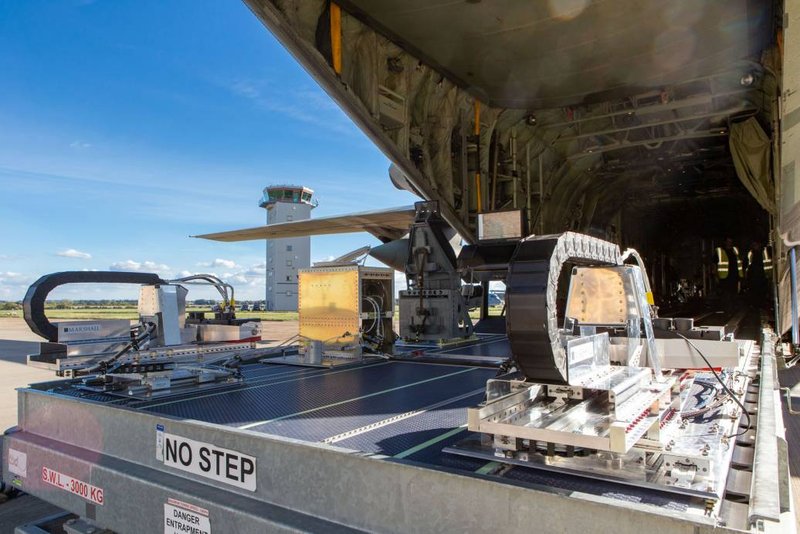
Two Osprey 30 AESA radars are fitted on a rear pallet mount. (Photo: Marshall Aerospace)
The system can be fitted or removed in under four hours, with no modifications needed to to the airframe and no performance or handling penalties, Marshall claims.
‘The unique benefit of this roll-on-roll-off system is that it effectively expands the utilisation of existing assets for multi-mission purposes,’ said Ben Jakubowski, head of Marshall Aerospace’s future products team.
ARC-Radar has undergone flight and ground testing on a Lockheed Martin C-130J Super Hercules platform.
Related Equipment in Defence Insight

More from Air Warfare
-
![UK eyes lightweight satellite communications for UAVs]()
UK eyes lightweight satellite communications for UAVs
The UK is seeking to extend the operational reach of uncrewed aerial vehicles, reflecting growing demand for compact, energy-efficient technology to support beyond-line-of-sight operations.
-
![The new generation of defence companies emerging from the US UAV boom]()
The new generation of defence companies emerging from the US UAV boom
As the Pentagon accelerates procurement of low-cost, lethal UAVs through its Drone Dominance Program, emerging suppliers will need to demonstrate manufacturing capacity, supply chain resilience and reliability.
-
![US Coast Guard faces key procurement decisions after C-130J and MQ-9B orders]()
US Coast Guard faces key procurement decisions after C-130J and MQ-9B orders
The service is updating several parts of its aviation fleet including fixed-wing and rotary-wing aircraft and procuring uncrewed aircraft to boost its maritime surveillance.