Leonardo’s Proteus concludes ground tests with maiden flight on horizon
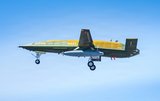
The Proteus demonstrator at Leonardo’s Yeovil site. (Photo: UK Royal Navy)
The technology demonstrator forms part of a wider effort to help the Royal Navy explore the potential of uncrewed systems supporting its existing crewed aviation platforms.


Leonardo’s uncrewed helicopter, Proteus, has progressed one step further along its path to first flight, with the conclusion of successful ground tests, the UK Royal Navy (RN) has confirmed.
Senior officers from the RN and UK MoD officials were present at Leonardo’s Yeovil site, where the Proteus aircraft is being designed and manufactured, to witness the aircraft power up with engines, rotor blades and systems tested.
As Shephard reported in June this year, Proteus had been undergoing test and evaluation at Yeovil with structural testing nearing completion. A first flight was forecast for Q3 or Q4 2025 – moved back from
Our news & analysis is now part of Defence Insight®
A Basic-level or higher Defence Insight subscription is now required to view this content.



More from Air Warfare
-
![UK A400M Saudi deployment highlights airlifter’s role as Airbus pursues upgrades]()
UK A400M Saudi deployment highlights airlifter’s role as Airbus pursues upgrades
Airbus is developing new capabilities for its A400M transport aircraft as European countries consider future airlift requirements and the UK plans to deploy the aircraft to Saudi Arabia.
-
![US Coast Guard faces key procurement decisions after C-130J and MQ-9B orders]()
US Coast Guard faces key procurement decisions after C-130J and MQ-9B orders
The service is updating several parts of its aviation fleet including fixed-wing and rotary-wing aircraft and procuring uncrewed aircraft to boost its maritime surveillance.
-
![Sophistication versus simplification: the divided future of air-to-air missiles]()
Sophistication versus simplification: the divided future of air-to-air missiles
As global air combat operations continue to evolve at a rate not seen for decades, what will the next generation of air-to-air weapons look like, and what missions will they need to fulfil?
-
![AUSA 2026: New multiwarhead loitering munition enters increasingly competitive market]()
AUSA 2026: New multiwarhead loitering munition enters increasingly competitive market
Heaviside Industries has unveiled its new Tyr loitering munition at AUSA 2026 in Washington, DC, joining a growing field of manufacturers seeking to capitalise on billions of dollars in anticipated military spending.
-
![Middle Eastern demand opens fresh export prospects for Lockheed Martin’s F-35 fighter jet]()
Middle Eastern demand opens fresh export prospects for Lockheed Martin’s F-35 fighter jet
A proposed Saudi Arabian purchase of 48 stealth fighters could signal a broader regional opportunity for the F-35 as European programmes mature.