Leonardo’s new approach to Air Surveillance and Defence: “the true game changer” (sponsored)
Integrated Air and Missile Defence architectures are attracting the attention of military forces worldwide.
This article is brought to you by Leonardo.
There are an increasing number of geopolitical scenarios which require absolute dominance of the airspace, irrespective of the diversity of threats and of the associated operational complexity. Therefore it comes as no surprise that Integrated Air and Missile Defence (IAMD) architectures are attracting the attention of military forces worldwide.
The purpose of an IAMD is to coordinate in real-time all available sensors and weapons, making it possible to counter conventional and unconventional air threats, manned and unmanned, air-breathing well as ballistic, possibly combined, and simultaneously. Due to the presence now of hypersonic air threats, clearly jeopardising the effectiveness of traditional air defence postures and systems, the need for IAMD capabilities is even more significant.
In this context, Leonardo’s innovative technology represents a game changer in Air Surveillance and Missile Defence. The Company is delivering immediate operational and cost benefits with its radars and maintains effective implementation of such architecture, unlike any other radars present on the market today.
Leonardo’s KRONOS radars, based on Leonardo’s proprietary AESA advanced technology (Active Electronically Scanned Array), are unique to the market because they are fully equipped to exploit the technical capability of the radar to perform multiple radar functions simultaneously, whilst using the same radar to perform multiple operational missions.
In terms of technical and operational performances, KRONOS radars are best in class, through their superior detection of all air threats, from very low up to very high altitude, and extreme tracking accuracy, irrespective to targets flying at a very low speed or at a very high speed.
In accordance with the tactical needs of the customer/operator, different versions of KRONOS radar are available and in production, in a fixed or mobile configuration: the basic KRONOS for Short Range applications; the KRONOS GRAND for Medium/Long Range applications; and the KRONOS POWER SHIELD for Very Long Range applications.
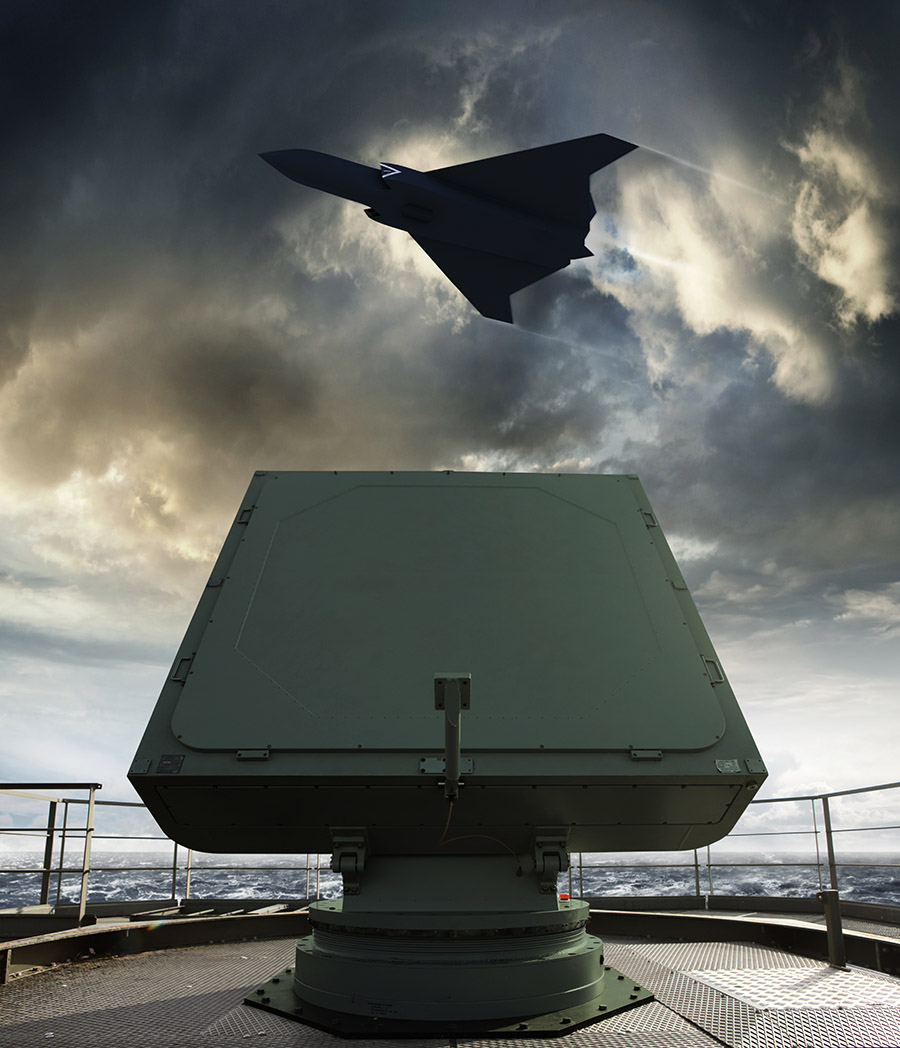
Each KRONOS radar is fully equipped to operate as Air Surveillance Radar, providing persistent and permanent (24/7) surveillance of the airspace, and to operate as well as Surveillance and Fire Control Radar, providing all the search and track functions needed for a Surface to Air Missile to engage, at the same time, multiple air targets with multiple missiles
The adoption of a single Land Based KRONOS radar fulfils, at the same time, operational requirements in terms of Air Surveillance and operational requirements for Air and Missile Defence, therefore reducing the number of radars needed on the field to achieve the full dominance of the airspace, with huge savings in terms of procurement and operational costs.

Further benefits of adopting KRONOS radars include the possibility to create a network of smart sensors that operate in a coordinated way, adapting in real-time their performances to the operational scenarios.
Smart radar networks are clearly a “sine qua non” component of IAMD architecture and the building block for a definitive concept of a completely unmanned and distributed radar network which provides surveillance and fire control services to all connected IAMD users with minimum intervention of human operators.
IAMD architectures based on a smart network of KRONOS radars guarantee flexibility to integrate different types of SAMs (Surface to Air Missiles), as required by customer specific operational needs.
Today more than 50 radar systems equipped with KRONOS have been sold by Leonardo and are fully operative worldwide. Smart radar networks based on KRONOS have also been already implemented by Leonardo for prominent customers, through Leonardo specific, specialised and Cyber-Secure Command, Control and Communication solutions, proving on the field their technical and operational effectiveness.
The Leonardo product catalogue includes best in class, certified IFF (Identification Friends or Foe) systems, including Secondary Radar Antenna, Interrogators, Transponders and Crypto equipment for air, land and naval radars and platforms. Leonardo’s IFF/SSR (Secondary Surveillance Radar) comprehensive solutions operate all existing IFF Modes, comprising of the latest NATO Military standard Mode 5, and National Specific Modes which can also be delivered as needed. KRONOS radars are therefore equipped as well with the appropriate and fully integrated IFF solution, matching customer specific interoperability requirements.




More from Air Warfare
-
![Quantum Systems details 480km/h Ukrainian interceptor as production scales up]()
Quantum Systems details 480km/h Ukrainian interceptor as production scales up
Quantum Systems’s Ukraine-made interceptor SPYS is thought to cost approximately 10 times less than Russia's jet-powered uncrewed aerial systems and is being produced at scale.
-
![UK eyes lightweight satellite communications for UAVs]()
UK eyes lightweight satellite communications for UAVs
The UK is seeking to extend the operational reach of uncrewed aerial vehicles, reflecting growing demand for compact, energy-efficient technology to support beyond-line-of-sight operations.
-
![Loyal wingman programmes gather pace as US and European procurement plans take shape]()
Loyal wingman programmes gather pace as US and European procurement plans take shape
Northrop Grumman, Airbus and Anduril are positioning their uncrewed aerial vehicles for future collaborative combat aircraft contracts in a market that is forecast to exceed $36 billion.
-
![UK A400M Saudi deployment highlights airlifter’s role as Airbus pursues upgrades]()
UK A400M Saudi deployment highlights airlifter’s role as Airbus pursues upgrades
Airbus is developing new capabilities for its A400M transport aircraft as European countries consider future airlift requirements and the UK plans to deploy the aircraft to Saudi Arabia.
-
![The new generation of defence companies emerging from the US UAV boom]()
The new generation of defence companies emerging from the US UAV boom
As the Pentagon accelerates procurement of low-cost, lethal UAVs through its Drone Dominance Program, emerging suppliers will need to demonstrate manufacturing capacity, supply chain resilience and reliability.