JADC2 objectives prompt adoption of software-defined networking
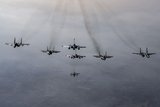
Hughes is working with the USAF to develop the Advanced Battle Management System. (Photo: USAF)
Through software-defined networking for multi-transport paths such as SATCOM, Hughes is supporting the DoD concept for Joint All-Domain Command and Control.


Traditionally, each branch of the US military developed its own tactical communications network. Addressing different needs and requirements for different services, these networks evolved divergently to be incompatible with each other.
As the nature of the military operating environment evolves, however, this incompatibility has become a significant challenge for the DoD.
The National Defense Strategy (NDS), published in 2018, describes an environment that is increasingly characterised by A2/AD capabilities. In this context, the NDS described how fast access to data and information will be crucial to maintain a strategic and tactical edge for US forces, making rapid information exchange –
Our news & analysis is now part of Defence Insight®
A Basic-level or higher Defence Insight subscription is now required to view this content.

More from Air Warfare
-
![UK eyes lightweight satellite communications for UAVs]()
UK eyes lightweight satellite communications for UAVs
The UK is seeking to extend the operational reach of uncrewed aerial vehicles, reflecting growing demand for compact, energy-efficient technology to support beyond-line-of-sight operations.
-
![Loyal wingman programmes gather pace as US and European procurement plans take shape]()
Loyal wingman programmes gather pace as US and European procurement plans take shape
Northrop Grumman, Airbus and Anduril are positioning their uncrewed aerial vehicles for future collaborative combat aircraft contracts in a market that is forecast to exceed $36 billion.
-
![UK A400M Saudi deployment highlights airlifter’s role as Airbus pursues upgrades]()
UK A400M Saudi deployment highlights airlifter’s role as Airbus pursues upgrades
Airbus is developing new capabilities for its A400M transport aircraft as European countries consider future airlift requirements and the UK plans to deploy the aircraft to Saudi Arabia.
-
![The new generation of defence companies emerging from the US UAV boom]()
The new generation of defence companies emerging from the US UAV boom
As the Pentagon accelerates procurement of low-cost, lethal UAVs through its Drone Dominance Program, emerging suppliers will need to demonstrate manufacturing capacity, supply chain resilience and reliability.
-
![US Coast Guard faces key procurement decisions after C-130J and MQ-9B orders]()
US Coast Guard faces key procurement decisions after C-130J and MQ-9B orders
The service is updating several parts of its aviation fleet including fixed-wing and rotary-wing aircraft and procuring uncrewed aircraft to boost its maritime surveillance.