How unconventional warfare demands are changing the CUAS and drone development landscape
Epirus’ Leonidas technology platform. (Photo: Epirus)
The use of drones in unconventional ways is accelerating technological advances and countermeasures as military planners try to stay ahead of the drone revolution in military affairs.


In early June, more than 100 Ukrainian drones concealed in hired lorries with remotely detachable roofs were driven to locations near multiple Russian airbases. Ukrainian forces then launched the drones remotely and commanded them — in some cases from thousands of miles away — to attack Russian strategic bombers. At least 13 Russian aircraft were destroyed according to Kyiv.
Meanwhile, as part of Tel Aviv’s surprise pre-emptive aerial strike against Tehran later the same month, Israel’s Mossad intelligence agency smuggled hundred of drone parts into Iran in luggage, trucks and even shipping containers and constructed a drone fleet inside Iranian territory, per the US-based Foundation for the Defense of Democracies think tank.
When Israel launched Operation Rising Lion, Mossad agents inside Iran launched these drones at Iranian air defence batteries and ballistic missile launchers, clearing the path through the defences for Israeli jets and damaging Iran’s later ability to retaliate against Tel Aviv.
Related Articles
The two incidents demonstrated how drones can achieve devastating surprise over an adversary state when combined with unconventional warfare tactics.
The effectiveness of the drone strikes was further increased in the Israeli case with Tel Aviv’s use of artificial intelligence (AI) systems to sort through the data its intelligence agencies gathered to find and prioritise targets to hit.
The use of concealed drone factories inside an adversary state’s territory and the use of mobile drone launchers disguised as civilian vehicles has dramatically demonstrated to global military planners both the vulnerability of conventional military units and infrastructure to such new pre-emptive strike tactics as well as the need to develop tougher anti-drone countermeasures to defend against worse-case scenarios. As a result, governments are scrambling to find ways to upgrade their militaries and military bases’ defences at the same time.
What does this mean for CUAS and drone development?
Western militaries are calling upon defence contractors to both develop their forces with more unconventional drone capabilities and to supply their clients with more effective means to counter surprise drone assaults.
In the UK, the government announced Project Volley in June, a commercial tender for companies to design a rapid-launch mobile drone product able to launch at least five unpowered drones in four minutes or under.
The launcher would need to be able to hide in plain sight, ideally deploying its weapon systems from a Transit van or Sprinter truck type vehicle, and be of robust and uncomplicated design. The UK’s Ministry of Defence (MoD)said the aim would be for the user to “use the launcher in a high threat environment with persistent enemy surveillance.”
The MoD is seeking designs that could be ready for testing by 25 October, a signal of Project Volley’s urgency following Ukraine’s demonstration of surprise drone launches using commercial vehicles.
Meanwhile, in France, Périgueux-based start-up Per Se Systems has developed a design for a mobile drone factory that can print a new drone every three hours for every one of the 10 3D printers the factory’s trailer carries.
This ensures it can print and launch up to ten drones per hour while remaining mobile to confuse enemy surveillance. This allows an army to create local drone fleets without needing extended logistical system chains that would be vulnerable to enemy detection and attack.
The company’s design for the French military reflects the experience of the war in Ukraine, where massive production of low-cost drones for precision-strikes against enemy targets has become a key tactic. The factor can be pulled by a light vehicle and is able to operate autonomously for up to 19 hours in the field.
Non-lethal systems’ unconventional roles are also growing
Not all developments involving drones and driving change in military involve lethal systems, however. Non-lethal drone systems have long been used by military and intelligence services for scout and spotting roles, but new designs are expanding their roles in logistics and transportation.
BAE Systems subsidiary Malloy Aeronautics’ Malloy T-150 drone is capable of lifting up to 68 kilos in all weather conditions. The drone has a removal battery that allows it to continue to operate without needing to stop for recharging. In April, the UK’s Royal Navy’s Carrier Strike Group employed the T-150 to transport defence equipment, food and packages between the fleet’s vessels for the first time. The drones’ use allowed naval commanders to reassign manned helicopters away from logistics duties and increase the amount of time they could spend in their primary fleet-protection role instead.
This shows that drones can also offer militaries a supportive role that frees up manned systems, in addition to their role as a first-strike weapon platform. Drones also have a well-established role for surveillance and spotter duties for drone-equipped militaries.
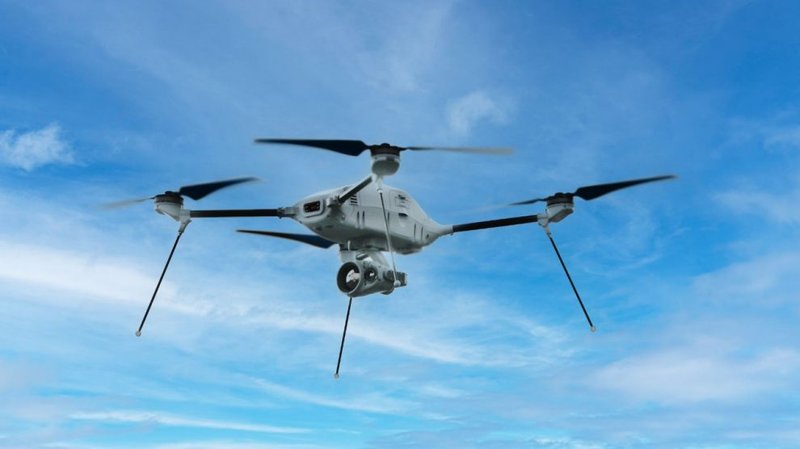
Since 2023, US firm Lockheed Martin has offered the UK’s MoD a range of small Intelligence, Surveillance, Target Acquisition, and Reconnaissance (ISTAR) drones under its TIQUILA programme. These include the man-portable Indago 4 reconnaissance quadrotor, the special forces’ Stalker model, and the VCSi drone, which is used to build 3-D terrain maps for military users. The programme gives UK units access to drones with AI-led automated target and threat recognition software, increasing their ability to target enemy units on the battlefield.
Force Protection against drone first-strikes
This summer’s surprise drone attacks against Russia and Iran have intensified defence company clients’ interest in acquiring countermeasures to protect military infrastructure and battlefield assets against such surprise attacks.
Defence technology startup Epirus has pioneered one such counter-drone system, the Leonidas IFPC-HPM. The company says its Leonidas HPM technology platform combines solid-state Gallium Nitride (GaN) amplifiers with an Active Electronically Scanned Array (AESA) and a software-defined backend that enables precision waveform development and control.
This technology involves firing a high-powered pulse of microwaves that disrupt or damage the electronic components in a drone, and can therefore destroy an entire swarm of drones with a single blast of radiation.
GaN technology delivers higher efficiency in a smaller, lighter form factor than traditional vacuum tube systems, making it better suited for mobile operations in the field and for scalable systems. Leonidas is air-cooled and only requires a small generator to power the system.
By building the system using an AESA instead of a horn antenna or fixed-aperture dish used in legacy systems, the system delivers highly directional, steerable beams, while the software-defined architecture allows operators to tailor waveforms in real time for specific threat profiles, including notching out specific frequencies, if needed, to protect critical communications or friendly systems. Using software, operators can also designate “safe zones” to ensure no collateral damage, further enhancing Leonidas’ operational safety.
Andy Lowery, CEO of Epirus, said: “The Leonidas HPM technology platform emits an invisible shield of electromagnetic energy to create a forcefield like effect, disabling the critical electronics of drones that attempt to enter its field of protection/
“From Ukraine’s audacious Operation Spider’s Web to Israel’s Operation Rising Lion, it is clear the asymmetric threat of drones needs to be taken seriously. The Leonidas platform was developed to ensure the US and its allies remain on the winning side of drone warfare. It’s highly scalable, safe for operators and blue forces and software-defined to ensure that as the threat evolves, so too will our air defence capabilities”.

The arms race between drone systems’ attacking capabilities and counter-measures to contain them is at present tilted in favour of the former.
Currently most efforts to block drones rely on electronic warfare to block or disrupt operators’ signals. But these have been countered by the development of drone models with on-board artificial intelligence that allows them to manoeuvre and select their own targets autonomously, or cheaper models where the operator uses fibre-optic cables to control the drone.
The development of concealed launchers like the UK’s Project Volley — and mobile drone factories able to create and deploy drone swarms at high local volumes — has only intensified drone systems’ offensive edge over conventional countermeasures.
This state of affairs is unlikely to last as governments pour resources into research and development projects to secure their military installations and senior personnels’ residencies. The very utility that has made using drones to aggressively strike at targets deep inside enemy territory is ultimately likely to drive defence companies to find new means to protect their clients from it.




More from DSEI 2025
-
![Could the Ajax IFV solve the UK’s Warrior capability gap?]()
Could the Ajax IFV solve the UK’s Warrior capability gap?
With the UK facing an imminent capability gap after the retirement of its Warrior infantry fighting vehicles (IFVs), the Ajax IFV appears to be in a prime position to fill that gap.
-
![DSEI 2025: Polaris displays new all-terrain vehicle with Alakran mortar system]()
DSEI 2025: Polaris displays new all-terrain vehicle with Alakran mortar system
The Polaris Government and Defense’s Military RZR (MRZR) Alpha 1KW was displayed at the Modern Day Marine exposition in the US earlier this year and with the Alakran mobile mortar weapon system at DSEI. The company outlined recent firing trials with the Alakran mobile mortar weapon system (MMWS) which was weeks after the company announced a major NATO deal.
-
![DSEI 2025: Thales creating new remote weapon station and Storm 2 counter-drone jammer]()
DSEI 2025: Thales creating new remote weapon station and Storm 2 counter-drone jammer
Thales launched Storm-H in 2012 as an EW system equipping individual dismounted troops, and a decade later revealed details to develop the improved and more powerful Storm 2.
-
![DSEI 2025: MARSS unveils new agnostic multidomain C4 system]()
DSEI 2025: MARSS unveils new agnostic multidomain C4 system
MARSS’ NiDAR system has been deployed using sensors from static platforms to provide detection and protection for static sights, such as critical infrastructure, ports and military bases.
-
![In depth: Competition for British Army vehicle programme heats up, despite more delays]()
In depth: Competition for British Army vehicle programme heats up, despite more delays
The UK’s Land Mobility Programme (LMP) seems set to be delayed once again but industry is jockeying for position to partner in what would be one of the biggest ever buys for the British Army.
-
![DSEI 2025: UK’s new Air Chief Marshal outlines nuclear, space and IAMD as three key priorities for RAF]()
DSEI 2025: UK’s new Air Chief Marshal outlines nuclear, space and IAMD as three key priorities for RAF
Aiming to field a more integrated, agile force, the military leader said in a keynote speech that focus on these core areas would be increased to help the RAF deter and meet challenges in the new threat landscape.