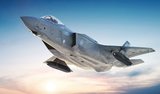
Heron TP flies over Germany for the first time
German Heron TP UAS taking off for its first flight over Germany. (Photo: Luftwaffe)
The Heron TP is a multi-role, advanced, long-range MALE UAS. It is faster, larger and higher flying than the Heron Mk 1 on which it is based and has been equipped with automatic taxi-takeoff and landing systems, satellite communication for extended range and fully redundant avionics.


An Israel Aerospace Industries’ (IAI) Heron UAV destined for the German Air Force flew for the first time in German air space on 15 May marking a major step towards the system achieving full operational capability.
The system was developed by produced by UAV Programme Executive Office at the Directorate of Defense, Research and Development at the Israeli MoD and IAI. The German Heron TP (GHTP) is a further development of Israel’s Heron TP.
Germany was an early adopter of the original platform, Heron 1, which it has used during deployments in Afghanistan and Mali for a number of years.
As part of an operational turnkey solution by Airbus, the GHTP RPAS will fill a gap in the field of persistent, airborne, intelligence surveillance and reconnaissance, with performance levels beyond Heron 1.
In addition to the provision and modification of the RPAS, the industrial operator model will also include the training of air force personnel, basic operation, maintenance and repair, both in theatre and as the provision of flight hours.
Shephard Defence Insight noted that the deal, signed in June 2018 between IAI and Airbus DS, was to lease and provide maintenance services for the Heron TP to the German Federal Ministry of Defence, with Airbus DS acting as the main contractor.
The US$600 million contract was for nine years and included options for content expansion including extending the lease period by a maximum of another three years.
Related Equipment in Defence Insight



More from Air Warfare
-
![Saab’s GlobalEye gains ground as Canada’s aircraft procurement tilts towards Europe]()
Saab’s GlobalEye gains ground as Canada’s aircraft procurement tilts towards Europe
Canada’s interest in negotiating a procurement of Saab’s GlobalEye airborne early warning and control aircraft signals its readiness to reduce its reliance on US defence technology as trade tensions with its North American neighbour mount.
-
![South American EW demand balances capability against cost]()
South American EW demand balances capability against cost
South American air forces are weighing advanced electronic warfare capabilities against limited budgets as Peru selects Viper Shield and BAE Systems targets smaller airborne platforms.
-
![September crewed air review: established platforms retain their grip on the market]()
September crewed air review: established platforms retain their grip on the market
With many next-generation capabilities still years from operational readiness, several of the month’s largest developments demonstrated that governments remain willing to invest heavily in aircraft with proven capabilities and established support networks.
-
![Will the US Navy F/A-XX and the USAF F-47 compete for production capacities?]()
Will the US Navy F/A-XX and the USAF F-47 compete for production capacities?
The two sixth-generation fighter programmes could battle for engineering talent and production lines before deliveries begin, testing Boeing’s industrial expansion plans.