Elbit Systems demonstrates UAV swarm capability to Dutch Army
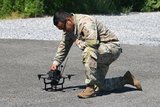
THOR mini-VTOL operates with PROBOT UGV. (Photo: Elbit Systems)
Elbit Systems has performed a demonstration of its UAV swarm capabilities to the Dutch Army in Northern Israel.


Elbit Systems has demonstrated its Robotic Autonomous Systems (RAS) capabilities for ISR missions utilising heterogeneous autonomous swarms to the RAS Concept Development & Experimentation programme of the Royal Netherlands Army.
The demonstration deployed swarms comprising of the PROBOT UGV and two types of vertical takeoff and landing mini UAS (VTOL mini-UAS) including the THOR, all powered by the TORCH-X RAS software suite.
During capability demonstration, different robotic pairings operated as swarms autonomously performing three types of operational missions such as planning, navigating to predefined points, allocating sectors and the performance of various ISR tasks.
The first mission used the THOR VTOL mini-UAS swarm to dominate the area of interest and deployed the PROBOT UGV to complete the intelligence picture.
In a second mission scenario, two VTOL mini-UASs were dispatched to resupply front line forces.
The third mission was an airborne deployment of Unattended Ground Sensors (UGS) using two THOR VTOL mini-UASs quipped with sensor dispensers.
The demonstration highlighted the capability of the TORCH-X RAS powered solution to enable heterogeneous formations of unmanned platforms, of different makers.
Related Equipment in Defence Insight

More from Air Warfare
-
![UK A400M Saudi deployment highlights airlifter’s role as Airbus pursues upgrades]()
UK A400M Saudi deployment highlights airlifter’s role as Airbus pursues upgrades
Airbus is developing new capabilities for its A400M transport aircraft as European countries consider future airlift requirements and the UK plans to deploy the aircraft to Saudi Arabia.
-
![The new generation of defence companies emerging from the US UAV boom]()
The new generation of defence companies emerging from the US UAV boom
As the Pentagon accelerates procurement of low-cost, lethal UAVs through its Drone Dominance Program, emerging suppliers will need to demonstrate manufacturing capacity, supply chain resilience and reliability.
-
![US Coast Guard faces key procurement decisions after C-130J and MQ-9B orders]()
US Coast Guard faces key procurement decisions after C-130J and MQ-9B orders
The service is updating several parts of its aviation fleet including fixed-wing and rotary-wing aircraft and procuring uncrewed aircraft to boost its maritime surveillance.