Can laser-guided rockets and light aircraft help tackle the CUAS cost-curve?
Portugal was the first European country to purchase the A-29N. (Photo: Embraer)
While the move to integrate lower-cost missiles onto more combat aircraft is long overdue, there is also an opportunity for cheaper turboprop platforms to perform CUAS roles.


Efforts to transform combat aircraft or light attack aircraft into effective counter-uncrewed aerial systems (CUAS) solutions have come to the fore in recent months, as armed forces grapple with how drones are changing the modern battlefield.
While multirole aircraft like F-35s have been used effectively to shoot down drones – shown recently with an RAF F-35 combat engagement over Jordan in March 2026 – one major issue that still faces industry and military forces is the cost imbalance posed by using such highly expensive platforms and missiles to destroy far cheaper uncrewed aerial vehicles (UAVs).
James Black, deputy director – defence and security; European lead, space at defence and security research group RAND Europe, noted that the advent of one-way attack (OWA) drones like the Iranian Shahed-136 has “sharply tilted” the cost-asymmetry towards the offensive – making efforts to find cheaper defensive alternatives paramount.
Related Articles
Embraer turns to AI solution for A-29 Super Tucano CUAS evolution
Ireland targets improved anti-drone capability before mid-year ahead of EU presidency
Europe has recently ramped up its acquisition of the AIM-120 Advanced Medium-Range Air-to-Air Missile (AMRAAM), with Germany becoming one of the latest countries to be approved for a US$1.23 billion acquisition for its F-35 programme. The AIM-120 is commonly used on combat aircraft from the F-35, F-15E, Typhoon and Gripen C/D.
Further APWKS II integration a “long-overdue” solution
Industry is busy working on this specific problem set by developing and integrating smaller, cheaper missiles and using laser-guided target systems on combat aircraft to counter UAS. In comparison to AIM-120 missiles, solutions like the AGR-20A Advanced Precision Kill Weapon System (APKWS) 70mm guided rocket remain a far lower-cost solution to deal with drones.
On 8 April, BAE Systems announced it had successfully completed a test firing of a laser-guided APKWS from a Eurofighter Typhoon. The test informed how low-cost weapons, namely CUAS weapons, could be integrated onto the aircraft when needed. It was part of a “range of capability enhancements planned for Typhoon to increase the aircraft’s potency in current and future combat air operations”, BAE Systems said.
The integration of the low-cost weapon on the multirole combat aircraft, according to the company, could prove a “game-changing” cost-effective solution for its CUAS role – with the initial tests now paving the way for the next stage of tests on air-to-air targets.
As noted on Shephard Defence Insight, the APKWS laser-guidance kit is already in use on the F-16 and F-15E. The Eurofighter Typhoon also already has access to a large range of air-to-air and air-to-surface weapons, including Meteor, Storm Shadow and Brimstone.
Justin Bronk, senior research fellow for airpower and technology at defence and security think tank Royal United Services Institute (RUSI), noted to Shephard that the recent tests of APWKS II on the Typhoon, as well as its current use on the F-16 and F-15E, was “an essential and long-overdue way of providing fast jets with a cost-effective interceptor for Shahed/Geran-class OWA drones”; missiles that could “be produced and carried in far larger numbers than traditional air-to-air missiles”.
Armed training turboprops offer opportunity
Training and light-attack turboprop aircraft, too, could prove effective options in the cost-balance challenge of combatting low-cost drones, with the aircraft proving a potentially untapped option to be used in CUAS interception roles. In Europe, Shephard currently forecasts a market opportunity of $1 billion for light attack aircraft.
Embraer has promoted its A-29 Super Tucano as an effective platform for CUAS operations, recently announcing a partnership with Valkyrie Aero to integrate an AI suite onto the aircraft. The aim, according to the company, is to provide operators with a low-cost CUAS capability, allowing for a precise engagement platform for guided rockets and effectors on the A-29.
Using armed turboprop aircraft to counter the growing UAS threat does not provide a catch-all solution, though. While Bronk pointed out that these aircraft could intercept OWA drones like the Shahed-136 or Gerna-2, it would “struggle to intercept jet-powered models” like the Geran-3.
Adding turboprop aircraft to armed forces’ inventories purely for CUAS interception roles, Bronk remarked, would “not [be] as easy as it might appear from just looking at upfront equipment costs”.
While integration of sensor pods or APWKS II could be a future option, the resultant weight would mean that only larger trainer and light-attack turboprops, such as the PC-9 or A-29 Super Tucano, would serve as suitable candidates.
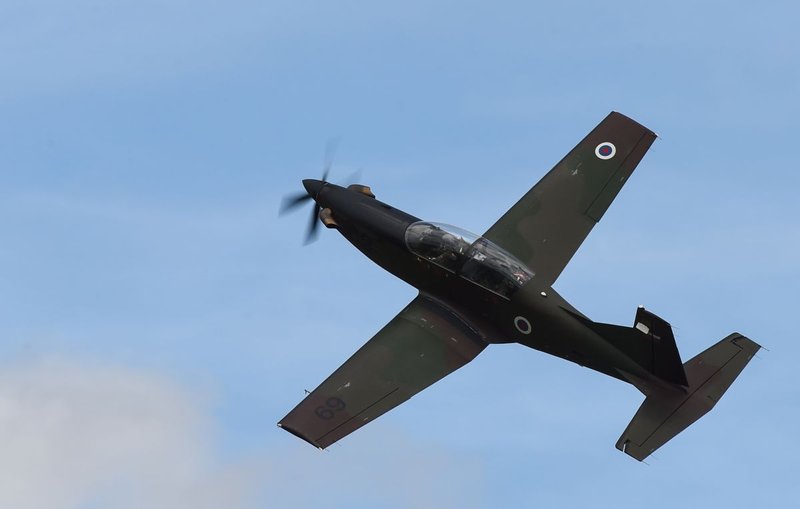
As noted on Shephard Defence Insight, in Europe the PC-9M is currently in use and operated by the Irish Air Force, Swiss Air Force and the Slovenian Air Force. The A-29, meanwhile, was ordered by Portugal in 2024 with the first five aircraft dispatched in 2025 – making it the first European and NATO customer for the A-29N.
The A-29 currently has two wing-mounted .50-calibre machine guns, electro-optical sensors and laser-guided rockets, which allow for a basic CUAS capability. Embraer previously told Shephard that its work to expand the A-29 Super Tucano’s missions set was “adding value” to air forces’ fleets and that it had seen interest from customers for the solution – although no timeline was given on when newer capabilities would be added to the platform, or what these would be.
In December 2025, Ireland unveiled its updated €1.7 billion ($2.3 billion) defence plan, which called for €19 million accelerated investment in CUAS platforms. While this didn’t explicitly outline upgrades to its PC-9M fleet, Bronk said that turning to the PC-9M to fill this CUAS interception role “could give them [Ireland and Slovenia] a valuable mission set that they currently lack in a European defence context, if their aircrew were trained to the task in realistic conditions at night on a regular basis”.
Arming training aircraft could also prove to be a cost-effective future opportunity for armed forces looking to bolster their CUAS capabilities during conflict.
Bronk explained: “There is an option to explore putting APKWS II and targeting pods on advanced jet trainer aircraft to enable air forces to use upgraded versions of trainer jets they are purchasing for fast jet training modernisation in an additional wartime role as CUAS interceptors.”
Related Equipment in Defence Insight


More from Air Warfare
-
![The new generation of defence companies emerging from the US UAV boom]()
The new generation of defence companies emerging from the US UAV boom
As the Pentagon accelerates procurement of low-cost, lethal UAVs through its Drone Dominance Program, emerging suppliers will need to demonstrate manufacturing capacity, supply chain resilience and reliability.
-
![US Coast Guard faces key procurement decisions after C-130J and MQ-9B orders]()
US Coast Guard faces key procurement decisions after C-130J and MQ-9B orders
The service is updating several parts of its aviation fleet including fixed-wing and rotary-wing aircraft and procuring uncrewed aircraft to boost its maritime surveillance.
-
![Sophistication versus simplification: the divided future of air-to-air missiles]()
Sophistication versus simplification: the divided future of air-to-air missiles
As global air combat operations continue to evolve at a rate not seen for decades, what will the next generation of air-to-air weapons look like, and what missions will they need to fulfil?
-
![AUSA 2026: New multiwarhead loitering munition enters increasingly competitive market]()
AUSA 2026: New multiwarhead loitering munition enters increasingly competitive market
Heaviside Industries has unveiled its new Tyr loitering munition at AUSA 2026 in Washington, DC, joining a growing field of manufacturers seeking to capitalise on billions of dollars in anticipated military spending.
-
![Middle Eastern demand opens fresh export prospects for Lockheed Martin’s F-35 fighter jet]()
Middle Eastern demand opens fresh export prospects for Lockheed Martin’s F-35 fighter jet
A proposed Saudi Arabian purchase of 48 stealth fighters could signal a broader regional opportunity for the F-35 as European programmes mature.
-
![US military plans multi-UAV trials with Northrop Grumman quantum-navigated Lumberjack]()
US military plans multi-UAV trials with Northrop Grumman quantum-navigated Lumberjack
An undisclosed US military branch is preparing to evaluate multiple Lumberjack Group 3 drones equipped with SandboxAQ’s AQNav magnetic-navigation system. Shephard spoke with Northrop Grumman and SandboxAQ to find out more.