Australia formally orders a dozen more Romeos
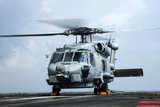
A dozen more MH-60R Seahawk helicopters have been ordered by the Royal Australian Navy from Sikorsky under the FMS programme. (Photo: RAN)
The Royal Australian Navy requires extra MH-60R helicopters under Project Sea 9100 Phase 1.


The USN has awarded Lockheed Martin company Sikorsky a contract to produce an additional 12 Sikorsky MH-60R Seahawk helicopters for the Royal Australian Navy (RAN) via the FMS programme.
As a result, Sikorsky claimed on 20 September, the RAN will gain a third Romeo squadron ‘of unparalleled capability to the RAN’s Fleet Air Arm’.
The helicopters will be delivered from mid-2025 to mid-2026.
According to the original FMS notification in October 2021, the Romeos plus associated equipment and services will cost about $985 million.
The RAN previously acquired 24 MH-60Rs between 2013 and 2016 as the first international customer for the aircraft.
The latest 12 helicopters are being procured under Project Sea 9100 Phase 1 (Improved Embarked Logistics Support Helicopter Capability) in line with the expansion of the RAN surface vessel fleet, and also to replace MRH90 Taipans.
Related Programmes in Defence Insight
Related Equipment in Defence Insight


More from Air Warfare
-
![Rafale AI trials highlight shift towards operational fighter testbeds]()
Rafale AI trials highlight shift towards operational fighter testbeds
Dassault’s latest Rafale trials join Gripen E and F-16 testing as developers explore how artificial intelligence could support and control combat aircraft.
-
![AFA 2026: US Air Force examines uncrewed cargo aircraft for contested logistics]()
AFA 2026: US Air Force examines uncrewed cargo aircraft for contested logistics
The US Air Force is evaluating demonstrators for uncrewed cargo missions as it considers logistics requirements across the Pacific and other contested environments.
-
![Germany air focus: Europe’s leading near-term air market targets domestic industry]()
Germany air focus: Europe’s leading near-term air market targets domestic industry
Between 2026 and 2032, almost a quarter of EU aircraft spending is expected to come from Germany. While crewed programmes seek modernisation and replacement, uncrewed opportunities look to introduce entirely new capabilities, with both highlighting sovereignty and domestic production.
-
![Europe risks losing control of CUAS production capacity as manufacturers look abroad]()
Europe risks losing control of CUAS production capacity as manufacturers look abroad
European counter-drone developers are securing early orders in the Middle East while slow domestic acquisition processes threaten to redirect production capacity, expertise and investment away from Europe.