New Zealand explores modular ship designs for future naval fleet
The RNZN's newest ship, tanker HMNZS Aotearoa at Devonport (foreground left) with the two ageing ANZAC frigates (background right). The frigate replacement project was delayed in the DCP 2019 but this presents an opportunity for a common hull replacement vessel across the wider fleet. (Photo: author)
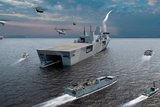
The New Zealand Ministry of Defence has started an industry engagement effort that aims to gather information about the future make-up of the Royal New Zealand Navy (RNZN), with a modular fleet based on just one or two basic ship designs being considered.


The industry engagement documentation, published on 8 September, warns that most of the RNZN fleet will reach the end of its service life in the mid-2030s and will need replacing.
However, it said that: ‘Rather than taking a “life-for-like” approach to replacement, there is a unique opportunity to consider alternative fleet configurations, alternative ways to operate and alternative approaches to support the fleet in the upcoming Defence Capability Plan (DCP).’
The MoD is asking for proposed concepts for future fleet configurations that will meet its existing capability requirements, outlining: the numbers and types of ships; use of autonomous systems, helicopters
Our news & analysis is now part of Defence Insight®
A Basic-level or higher Defence Insight subscription is now required to view this content.

More from Naval Warfare
-
![Industry sees opportunity in Australia’s shift to networked undersea warfare]()
Industry sees opportunity in Australia’s shift to networked undersea warfare
Australia’s new defence innovation strategy indicates a shift from platform-centric to network-centric undersea warfare, with Ocius and Anduril Industries pointing to fast-growing opportunities for local industry.
-
![Asia-Pacific emerges as the largest export market for US-made USVs]()
Asia-Pacific emerges as the largest export market for US-made USVs
Asian customers have placed one of the largest known international purchases of US-built uncrewed surface vessels, highlighting accelerating regional demand for autonomous maritime capabilities and distributed naval operations.
-
![RTX confirms US Marine Corps and US Navy acquire Hadalus UUV]()
RTX confirms US Marine Corps and US Navy acquire Hadalus UUV
RTX told Shephard that the Hadalus UUV has been procured by the US Marine Corps and the Office of Naval Research for operational experimentation as the company prepares additional demonstrations with the US Navy, NATO and AUKUS partners.