US warship cruises disputed sea in Philippine war games


A US warship laden with hi-tech fighter planes took centre stage at key war games in the Philippines on 11 April, brandishing military might as fresh tensions bubble in the contentious South China Sea.
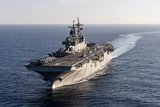
The amphibious assault ship USS Wasp, with at least 10 F-35B stealth jets on deck, stood guard as amphibious tanks rolled onto a Philippine beach located a short sail from islands also claimed by China.
The vessel was in the area for long-running US-Philippine military drills, which come as Manila pushes back against the recent presence of hundreds of Chinese ships near its Pag-asa (Thitu) island.
‘We can’t disclose the official movements of the USS Wasp for security reasons, but they have been operating in the South China Sea region... as part of the exercise,’ US spokeswoman Second Lieutenant Tori Sharpe told reporters.
President Rodrigo Duterte had largely set aside the once-tense dispute over China’s expansive claims to the resource-rich waterway, but told Beijing last week to back off over the ‘swarming’ Chinese boats. The Philippines called the boats’ presence “illegal” and Duterte threatened China with possible military action if it touches the island.
China claims most of the sea, including waters and islands close to the shores of its neighbours. It has built artificial islands and military installations that the US warned could curtail right of passage by non-Chinese vessels. The Philippines, Brunei, Malaysia, Taiwan and Vietnam have also all staked claims to various islands and reefs in the sea that is thought to have rich petroleum reserves deep beneath its waters.
The Wasp’s participation in the exercises represents ‘an increase in military capability committed to a free and open Indo-Pacific region,’ the US navy said in a press release on its arrival last week.
The two-week Balikatan (Shoulder-to-shoulder) exercises, which opened April 1, include some 4,000 Philippine, 3,500 American, and 50 Australian troops.
Duterte had threatened to quit the drills as part of his pivot away from former colonial master the US and toward China, but they have carried on after being toned down for a few years. As Duterte has adopted a friendlier stance with China, the US has moved to shore up its ties with Manila and assert its presence in the South China Sea.
US Secretary of State Mike Pompeo pledged in March to come to the Philippines’ defence in case of an ‘armed attack’ in the sea, a clear assurance Philippines leaders had long sought.
On 11 April a spokesman from China’s Ministry of Foreign Affairs re-asserted China’s claim to the island chain that includes Pag-asa, and said they had ‘consistently advocated the settlement of disputes in the South China Sea through negotiations with countries directly involved.’ The spokesman added that China-Philippine relations had ‘undergone transformation, consolidation, improvement, and entered comprehensive strategic cooperative relations.’
Duterte has been criticised at home as being too eager to grow ties with Beijing, and giving up too much leverage on the South China Sea issue.
China has been reserved in its comments regarding Manila’s recent uptick in assertiveness over the Pag-asa island, saying that it was working with the Philippines and looking into the reports regarding Chinese ships.



More from Naval Warfare
-
![Suppliers await next step in Australia’s mine warfare transition]()
Suppliers await next step in Australia’s mine warfare transition
Australia’s mine countermeasure capability remains in flux as the Huon-class nears retirement, but accelerated investment in autonomous systems is opening a path for industry.
-
![Can the US Navy ask Indo-Pacific allies to do more while training with them less?]()
Can the US Navy ask Indo-Pacific allies to do more while training with them less?
As the Iran War draws US ships and marine corps units away from the Indo-Pacific, curtailed exercises and a temporary carrier gap are exposing tensions between Washington’s demand for more self-reliant allies and the joint training needed to realise that ambition.
-
![How could Rheinmetall’s GMF 140 fit with ongoing programmes in North America?]()
How could Rheinmetall’s GMF 140 fit with ongoing programmes in North America?
With Canada committed to its River-class replacement and the USN pursuing a lower-cost frigate, Rheinmetall will need to demonstrate where the GMF 140 can fill a capability gap in the North American fleet.
-
![Australian industry programme builds pipeline for Virginia-class sustainment]()
Australian industry programme builds pipeline for Virginia-class sustainment
Australian businesses can now bid to support Virginia-class submarine sustainment in Western Australia, as momentum around the Henderson Defence Precinct also builds.
-
![South Korea, Japan and Turkey vie for US shipbuilding access in future frigate contest]()
South Korea, Japan and Turkey vie for US shipbuilding access in future frigate contest
Washington’s search for a foreign-built frigate could hand South Korea, Japan and Turkey a larger prize than a double-hull order: a foothold inside the US shipbuilding industrial base.
-
![Japan’s FY2027 budget bets on stand-off systems to offset demographic decline]()
Japan’s FY2027 budget bets on stand-off systems to offset demographic decline
Japan’s FY2027 defence budget backs stand-off strike, a 17-aircraft MQ-9B buy and a declared bid to lead the world in uncrewed maritime assets, alongside new frigates, submarines and support ships.