UK selects Harland & Wolff, Navantia and BMT team for support ships
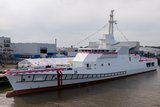
An artist's impression of the future Fleet Solid Support Ship that will keep RN surface combatants stocked with supplies while at sea. (Photo: Team Resolute)
New ships will take shape in Belfast once again following a decision by the UK MoD to choose Team Resolute to build the Royal Fleet Auxiliary’s (RFA’s) Fleet Solid Support ships.


The UK MoD has chosen Team Resolute – comprising Harland & Wolff, Navantia and BMT – as its preferred bidder for a £1.6 billion ($1.9 billion) project to build three new Fleet Solid Support (FSS) ships.
The decision represents a long-awaited conclusion to a programme vital for future UK Carrier Strike Group operations.
Navantia UK, a subsidiary of the Spanish shipbuilder, is prime contractor for the programme that will see finished ships assembled at Harland & Wolff’s Belfast shipyard. The decision is a boon for Harland & Wolff, which only this year won its first defence contract to refurbish an
Our news & analysis is now part of Defence Insight®
A Basic-level or higher Defence Insight subscription is now required to view this content.


More from Naval Warfare
-
![Five years on: where could opportunities emerge next for AUKUS Pillar II?]()
Five years on: where could opportunities emerge next for AUKUS Pillar II?
Payload commonality, combat systems and electronic warfare are emerging as likely priorities as the trilateral partnership balances building submarines with sharing industrial ecosystems.
-
![From the Baltic to the Gulf: where USV procurement is heading next]()
From the Baltic to the Gulf: where USV procurement is heading next
Saildrone’s new Copenhagen base is one sign of a larger shift, as navies globally turn to uncrewed vessels for surveillance and mine clearance.
-
![Quantum sensing gathers pace as navies eye undersea advantage]()
Quantum sensing gathers pace as navies eye undersea advantage
As AI dominates defence conversations, industry increasingly points to quantum sensing as the technology set to change submarine and uncrewed underwater vehicle operations.