Maritime defence in the Mediterranean faces challenges from vulnerable land power
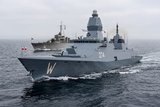
The French Navy’s Aquitaine-class frigate Provence was the first to receive the experimental DHE architecture two years ago. (Photo: US Navy)
As an indispensable energy crossroads, the Mediterranean is at serious risk from grey zone disruption. As navies increasingly employ AI data centres, what happens when cutting-edge defence technologies rely on the very infrastructure most susceptible to hybrid tactics?


The importance of resilience in civilian, military and critical infrastructure frameworks during times of increasing uncertainty was a key topic that came up at the SHADE MED conference held in November by EUNAVFOR MED Irini — the EU’s military operation in the Central Mediterranean — and NATO Maritime Command (MARCOM). The theme of the event, which is in its 14th year, was “The Mediterranean Space: A Pillar of Global Security.”
The prominence of this topic was hardly surprising: resilience has shaped the war in Ukraine, and every defence forum in recent years now anchors itself to the concept.
In the Mediterranean, that resilience translates into protecting Europe’s indispensable energy highway. Approximately 20% of global shipping transits through the region, while about 40% of Europe’s submarine communications cables lie on its seabed. Major oil and gas pipelines also cross or skirt the basin (Algeria-Italy, Maghreb-Europe, Medgaz and others), making it a central hub for Europe’s power and data supply.
Related Articles
New enhanced FREMM frigate delivered to Italian Navy
NATO experiments with solutions to integrate networks, AI and uncrewed systems
Naturally, the Mediterranean is now a prime target for Russian hybrid tactics. The notorious Yantar intelligence-gathering ship, for instance, is regularly observed operating in European waters — including the Mediterranean — to map critical underwater infrastructure (CUI).
To protect CUI, navies rely heavily on data fusion. Modern maritime awareness is not built on a single radar feed or a lone patrol aircraft; it is a layered picture assembled from sensors above, on and below the water.
Understanding contested environments
Marine predator algorithms (MPAs) and uncrewed aerial vehicles (UAVs) sweep wide areas with synthetic-aperture radar and electro-optical payloads. Surface combatants feed in automatic identification system (AIS) intercepts, navigation radars and electronic warfare (EW) detections. Hydrophone arrays, seabed sensors and uncrewed underwater vessels (UUVs) contribute acoustic tracks and anomaly alerts. Even coastal installations — civil and military — provide environmental data, traffic patterns and satellite cues.
All this converges into a single operational overview through AI-enabled data fusion engines. This is the backbone of how navies understand what is happening, in real time, across a sea as contested and congested as the Mediterranean.
Much of this digital backbone still relies on land-based data centres for processing, which demand uninterrupted power, cooling and secure connectivity to operate. This is where an uncomfortable paradox arises. The systems navies use to protect CUI are themselves exposed due to the fragility of infrastructure ashore. A cyberattack on a data centre or national grid, or an interruption to the connectivity feeding it, might severely degrade a navy’s ability to maintain the full maritime awareness picture it needs.
This is why pushing more processing out to sea — for example, the French Navy’s move towards afloat data hubs — is becoming essential to circumvent this vulnerability.
Since 2020, the French Navy has stood up a dedicated Data and Artificial Intelligence Service Centre (CSDIAM) in Toulon and, working with industry partners such as Naval Group and Thales, has developed a data hub embarqué (DHE) architecture for its frontline units.
DHE experiments across French platforms
The first experimental DHE was installed on the frigate Provence (D652) two years ago to capture, store and cross-analyse raw data from the combat system, optronic sensors, EW suites and intelligence feeds that had previously lived in separate silos. Early trials showed that by fusing these datasets on board, watch teams could resolve ambiguous tactical situations that the legacy combat system had struggled to interpret, gaining earlier and more precise understanding of the environment.
On the back of those results, the navy expanded the trial during the 2025 deployment CLEMENCEAU 25, fitting DHE packages to six platforms in its carrier strike group — the aircraft carrier Charles De Gaulle, several escort frigates, a submarine, a maritime patrol aircraft and a helicopter — to test force-level data fusion at sea.
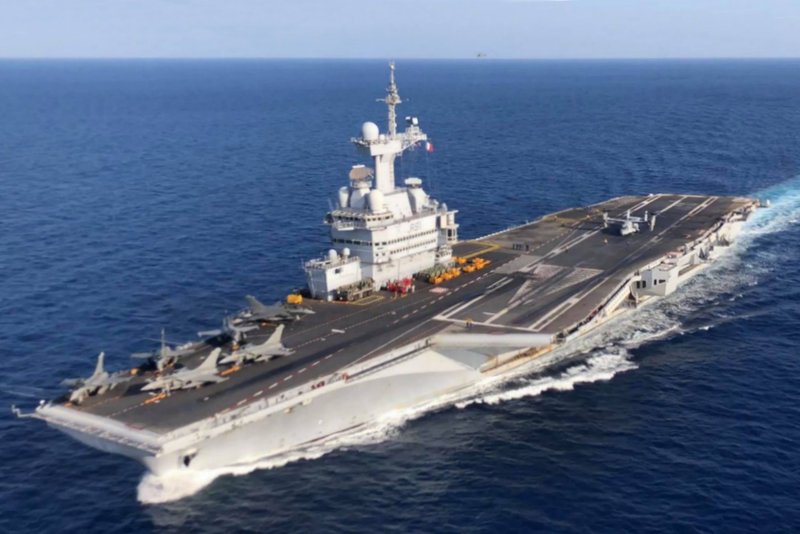
The aim is for each unit to host its own local data hub, while allowing commanders to cross-correlate information at the level of the whole force.
It is not a wholesale replacement — no ship can match the computational footprint of a dedicated data centre — but it adds resilience where it matters: closer to the mission and harder to disrupt.
In short, the Mediterranean may be Europe’s energy and digital crossroads, but its critical infrastructure is also an inviting pressure point for grey zone hostile actors. Navies are adapting, but the dependency chain between data fusion and vulnerable undersea infrastructure is a gap that can no longer be ignored.
This year’s iteration of SHADE MED framed the Mediterranean as a pillar of global security, and it is. But it also exposes the weak links in the West’s own systems. The more navies depend on AI-driven fusion, the more attractive those links become to anyone using the hybrid warfare playbook.
Resilience now means looking beyond hulls and hardware, and protecting the digital backbone that ties it all together. Some of that will happen ashore; more activity will have to move out to sea. Either way, the picture is clear: the Med remains a pillar of security only if the infrastructure beneath it holds.
This analysis article originally appeared in November’s Decisive Edge Naval Warfare Newsletter. Don’t want to miss out on future Decisive Edge content? Make sure you are signed up to our email newsletters.
Related Equipment in Defence Insight



More from Naval Warfare
-
![Autonomy gives Turkey a chance to outflank established naval shipbuilders]()
Autonomy gives Turkey a chance to outflank established naval shipbuilders
Turkish shipbuilders have sold ships from Asia to Europe, but autonomy and swarm technology could give them a fairer fight against Western European rivals.
-
![Canada assesses security equipment changes for Polar Icebreaker Imnaryuaq]()
Canada assesses security equipment changes for Polar Icebreaker Imnaryuaq
The Canadian Department of National Defence is evaluating communications and reconnaissance changes for CCGS Imnaryuaq’s expanded maritime security role, while retaining its 2032 acceptance target.
-
![US Navy’s MQ-25 Stingray approaches carrier-integration tests]()
US Navy’s MQ-25 Stingray approaches carrier-integration tests
Boeing has outlined its upcoming precision-landing and carrier-airspace trials as MQ-25 manufacturing shifts towards Illinois, with initial Lot 1 deliveries expected in 2029.
-
![From Poland to the Pacific: can Miecznik become a blueprint for other navies?]()
From Poland to the Pacific: can Miecznik become a blueprint for other navies?
Babcock is taking its Polish industrial partnership approach to Denmark and New Zealand as navies seek sovereign shipbuilding skills alongside ships.