UK accesses FMS programme with Tomahawk request
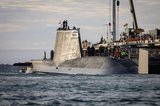
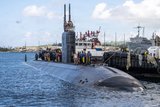
Tomahawk launched from a UK RN submarine. (Photo: UK MoD/Crown Copyright)
Will the UK emulate US efforts to upgrade its Tomahawk cruise missiles to Block Va and Block Vb configuration?


The UK is requesting $368.53 million worth of follow-on support services and related equipment for its Tomahawk naval cruise missile via the FMS programme, the US State Department announced on 29 March.
Raytheon would be the prime contractor on the deal if it is approved by Congress.
The UK RN would receive support for all elements of the Tomahawk Weapon System: the All Up Round (AUR), the Tactical Tomahawk Weapon Control System (TTWCS) and the Theater Mission Planning Center (TMPC).
The UK currently operates the Block IV long-range precision strike variant of Tomahawk but its new FMS request may reflect a desire to align with US recertification efforts to Block Va (which includes a multimode seeker) and Block Vb (which includes an improved warhead to penetrate hard and deeply buried targets).
Tomahawk capability is currently confined to RN submarines but the Daring-class Type 45 destroyers could (in theory) be retrofitted with a Sylver A70 Vertical Launching System that can fire the cruise missile.
Likewise, the City-class Type 26 and Inspiration-class Type 31 frigates will have VLS tubes long enough to launch Tomahawk.
Related Equipment in Defence Insight



More from Naval Warfare
-
![Five years on: where could opportunities emerge next for AUKUS Pillar II?]()
Five years on: where could opportunities emerge next for AUKUS Pillar II?
Payload commonality, combat systems and electronic warfare are emerging as likely priorities as the trilateral partnership balances building submarines with sharing industrial ecosystems.
-
![Singapore expands maritime presence with future-ready Sentinel OPV]()
Singapore expands maritime presence with future-ready Sentinel OPV
Singapore is building space for uncrewed systems and future technologies into its new Sentinel-class OPVs, reflecting a wider move towards adaptable vessels capable of maintaining persistent maritime presence.
-
![From the Baltic to the Gulf: where USV procurement is heading next]()
From the Baltic to the Gulf: where USV procurement is heading next
Saildrone’s new Copenhagen base is one sign of a larger shift, as navies globally turn to uncrewed vessels for surveillance and mine clearance.
-
![Israeli Navy looks to expand as war reshapes future force requirements]()
Israeli Navy looks to expand as war reshapes future force requirements
Israel’s navy is preparing for a larger and more technically diverse role, but its ambitions could be impacted by supply chain restrictions, accelerating demand for domestic naval production as well as autonomous maritime capabilities.
-
![Quantum sensing gathers pace as navies eye undersea advantage]()
Quantum sensing gathers pace as navies eye undersea advantage
As AI dominates defence conversations, industry increasingly points to quantum sensing as the technology set to change submarine and uncrewed underwater vehicle operations.