Thales’ APAR completes first Sea Acceptance Test


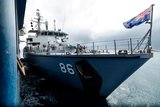
Thales’s multi-function Active Phased Array Radar (APAR) has undergone the first Sea Acceptance Test (SAT) on the new Iver Huitfeldt Class frigates of the Royal Danish Navy with positive results. The test was performed with the first APAR delivered to the Royal Danish Navy, installed on HDMS Peter Willemoes.
Thales delivered three APAR systems for the Iver Huitfeldt Class frigates under a contract signed in December 2006. Between 2011 and 2012 the systems were installed on the three ships of this class: HDMS Iver Huitfeldt, HSMS Peter Willemoes and HDMS Niels Juel.
APAR is a multi-function radar (MFR) designed to perform various tasks simultaneously, including the automatic detection and tracking of low altitude targets (such as sea skimmers), detection and tracking of air targets and missile guidance support. It is designed for the terminal guidance (CW/ICWI) requirements of SM-2 and ESSM missiles. ICWI is Interrupted Continuous Wave Illumination. This feature enables a single fire control radar to control several missiles simultaneously, thereby enhancing a ship’s defence capabilities.
The APAR antenna consists of four arrays, each array composed of more than 3000 very small radar transmitter/receiver (T/R) elements. The combination of T/R modules in one array can generate narrow beams that can be pointed in any direction within a cone of about 140 degrees in azimuth and 85 degrees in elevation. Combined, the four arrays cover the full 360 degrees. Switching from one beam to another can be done very rapidly. The use of so many T/R modules gives this radar unique performance and high operational availability. The inherent agility of APAR guarantees a high performance in the most adverse conditions, under severe electronic protection measures.
Gerben Edelijn, CEO, Thales Nederland, said of the SAT: ‘This SAT demonstrates our capability to maintain the highest possible level of product quality over a long period of time. We are proud of the excellent relation with the Royal Danish Navy.’
Following this SAT, there will be a Harbour Acceptance Test later this year to test the ship’s Anti Air Warfare and Fire Control capabilities. The programme is scheduled to end early 2014.



More from Naval Warfare
-
![Suppliers await next step in Australia’s mine warfare transition]()
Suppliers await next step in Australia’s mine warfare transition
Australia’s mine countermeasure capability remains in flux as the Huon-class nears retirement, but accelerated investment in autonomous systems is opening a path for industry.
-
![Can the US Navy ask Indo-Pacific allies to do more while training with them less?]()
Can the US Navy ask Indo-Pacific allies to do more while training with them less?
As the Iran War draws US ships and marine corps units away from the Indo-Pacific, curtailed exercises and a temporary carrier gap are exposing tensions between Washington’s demand for more self-reliant allies and the joint training needed to realise that ambition.
-
![How could Rheinmetall’s GMF 140 fit with ongoing programmes in North America?]()
How could Rheinmetall’s GMF 140 fit with ongoing programmes in North America?
With Canada committed to its River-class replacement and the USN pursuing a lower-cost frigate, Rheinmetall will need to demonstrate where the GMF 140 can fill a capability gap in the North American fleet.
-
![Australian industry programme builds pipeline for Virginia-class sustainment]()
Australian industry programme builds pipeline for Virginia-class sustainment
Australian businesses can now bid to support Virginia-class submarine sustainment in Western Australia, as momentum around the Henderson Defence Precinct also builds.
-
![South Korea, Japan and Turkey vie for US shipbuilding access in future frigate contest]()
South Korea, Japan and Turkey vie for US shipbuilding access in future frigate contest
Washington’s search for a foreign-built frigate could hand South Korea, Japan and Turkey a larger prize than a double-hull order: a foothold inside the US shipbuilding industrial base.