Managing risk in a changing world: how the Royal Navy can win
A fighting force such as the Royal Navy must inevitably focus on its core capabilities, platforms and readiness. But to avoid unexpected outcomes and costly oversights, a complex organisation like this needs to be underpinned by sound enterprise-level risk management principles and systems.


Enjoy free access to this sponsored article, all content provided by Amentum
Amentum provides project, programme and enterprise management, advanced engineering, technology solutions, and mission support to enhance military readiness and national security in the USA, UK, Australia and elsewhere.
The Royal Navy oversees a wide-ranging enterprise covering a myriad of activity to enable its primary missions of deterring adversaries and protecting the nation. This includes maintaining and supporting platforms, together with upgrades and new-build projects and programmes to introduce fresh capabilities.
The Navy faces additional challenges from the rate of change in equipment, platform and battlefield requirements. This often outpaces support infrastructure and decision timescales and creates a mismatch of operational and financial aspirations, compounded by potentially optimistic initial cost estimates, which later lead to impacts on other key projects, programmes and operational activities.
Increasing operational demand is magnifying these impacts and causing increased stress on the structures and approaches used to manage the portfolio of activity.
Siloed cultures inhibit the effectiveness of leadership and engagement, leading to friction and wastage. Key individuals running projects and programmes are judged on criteria which do not always align with what is best for the enterprise as a whole.
Adopting approaches
However, the Navy’s challenges are not unique. Experiences and approaches which have been successfully adopted elsewhere could enable better visibility and management of these risks.
An example of this might be tracking the performance and business security of suppliers, who nominally sit outside the enterprise, but nevertheless provide key sub-components.
To illustrate this, the submarine shiplift at HM Naval Base Clyde used to rely on three-inch floppy disks, and there was a sudden realisation that the last manufacturer of these disks had stopped making them, so it rapidly became necessary to buy up all the available stock on the market to provide sufficient reserves whilst a new operator/user interface system was designed, approved and implemented.
Recognising such dependencies and threats to them – and so to critical infrastructure and systems – is essential but often requires tracing back through several levels of sub-component.
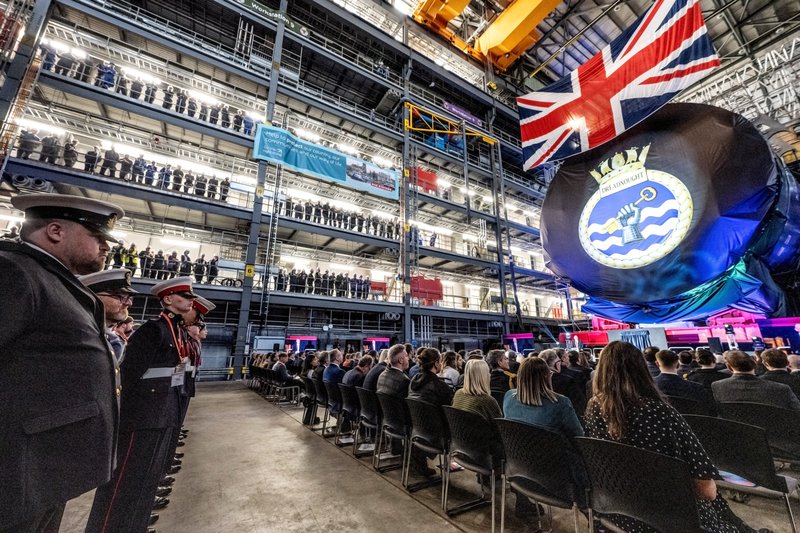
Another example is the requirement that the timber used as cappers in submarine dry dock support cradles should be from the slow-growing Douglas fir, of which there is a limited set of appropriate suppliers. With a single team looking across all the infrastructure requirements for the Dreadnought programme, it was recognised that there was a risk of not having sufficient timber at the right times if each project within the enterprise acted alone and without wider consideration.
Conversely, by taking a coordinated approach, the risk was mitigated and an opportunity realised to get a better overall price for the Navy.
Risk management – particularly at an enterprise level – requires brute effort, rigour and discipline; involving people with a broad, as well as deep, understanding of the enterprise (including key underpinning assumptions and their continuing validity), to identify the connections between activities and outcomes, and emergent changes, taking informed decisions on risks and how to mitigate them.
System-of-Systems Approach
To enable risk awareness, informed decision-making and effective portfolio management, we recommend using the Project 13 and Management of Portfolios frameworks and bespoke methodologies such as our System-of-Systems Approach (SoSA).
The Institution of Civil Engineers introduced the Project 13 delivery approach, which identifies five areas critical to enabling an integrated enterprise:
- Capable owner: The owner sits at the heart of the enterprise, not just as the owner of the assets, but also as the owner of the outcomes for the customers and/or users.
- Governance: There needs to be a shift in focus from price to value. Commercial arrangements and incentives will be aligned with customer outcomes and whole-life cost.
- Organisation: Enterprise organisations will increasingly be coalitions of partners and suppliers working with aligned commercial interests (aligned to the objectives of the enterprise) within a defined framework.
- Integration: An effective integrator will pull together the partner ecosystem to deliver the required outcomes. It entails integration across the end-to-end delivery process.
- Digital Information: Effective information management across the enterprise and throughout the delivery process will be a key enabler of success.
- The Management of Portfolios framework encourages uniform and coherent ways of delivering programmes and portfolios and offers a secure foundation for assurance, risk management and decision-making. It focuses on six key enterprise functions/activities: business as usual; strategic/business planning; budgeting and resource allocation; programme and project management; performance management; and corporate governance.
Amentum’s SoSA is designed to drive best-practice systems engineering to improve delivery of effective and affordable military capability. SoSA is a response to the challenges of increasingly complex capability design, acquisition and operating environments and majors on identifying and addressing dependencies.
In delivering SoSA tasks, Amentum provides a range of tools that improve communication and collaboration between the various independent organisations responsible for managing the acquisition of systems within the military environment.
One thing is clear: the Royal Navy should consider changing its approach to enterprise risk management to ensure it has the right level of planning, rigour, consistency and sophistication of process to keep on top of the increasing scale and complexity of the challenges ahead.
About the author - Martin Ewence, Maritime Domain Director, Amentum
During 33 years’ military experience on sea and land, Martin served in conflict zones from the South Atlantic to Afghanistan, the Gulf of Guinea, the Indian Ocean, the Arabian Gulf and the South China Sea. His major tours included command of the destroyer HMS Liverpool in Gulf War 2, senior liaison officer in Pakistan for the NATO Chief in Afghanistan, and Chief of Staff to the NATO Counter-Piracy Squadron in the Indian Ocean. Post Gulf War 2 he was appointed an OBE in the Operational Honours List.




More from Industry Spotlights
-
![Orchestrating operational readiness across every defence domain]()
Orchestrating operational readiness across every defence domain
Are all systems ready for the next mission? Have upgrades been applied? Are all assets aligned to deploy together, on time and fully prepared? In modern defence operations, readiness is no longer measured platform by platform. It is measured by how well people, assets, data and decisions move together — across land, sea and air.
-
![Extending mission readiness: where XR adds real value in pilot, crew and maintenance training]()
Extending mission readiness: where XR adds real value in pilot, crew and maintenance training
Extended reality (XR) is becoming increasingly relevant in military aviation training, adding a flexible layer to an integrated ecosystem spanning the pilot, crew, and maintenance domains.
-
![Dominating the spectrum: ASELSAN’s EW capabilities take center stage at MSPO 2026]()
Dominating the spectrum: ASELSAN’s EW capabilities take center stage at MSPO 2026
ASELSAN is showcasing its advanced electronic warfare (EW) capabilities at MSPO 2026, highlighting technologies designed to detect, analyse, disrupt and deceive threats across increasingly contested electromagnetic environments.
-
![“Creating a decision advantage”: how C-UAS is evolving to reduce the operator burden]()
“Creating a decision advantage”: how C-UAS is evolving to reduce the operator burden
In Conversation… Speaking to Shephard’s Gerrard Cowan, Dr Brian Shand, Director – Advanced Concepts & Technology at L3Harris, explains how, as operators face growing numbers of low-cost drones, C-UAS providers must focus on reducing operator workload, transforming fragmented sensor data into effective decision-making.
-
![Shield the warfighter, win the fight (video)]()
Shield the warfighter, win the fight (video)
BAE Systems’ Intrepid Shield™ approach delivers full-spectrum electromagnetic protection to detect, exploit, and counter advanced threats.
-
![How joint ventures are expanding Rheinmetall's munitions portfolio (video)]()
How joint ventures are expanding Rheinmetall's munitions portfolio (video)
Roman Köhne, CEO of Rheinmetall's Weapon and Ammunition Division, discusses the company's announcements at Eurosatory 2026, including developments in defence technology, precision systems, industrial partnerships and future capability programmes.