BlueWhale - A True Submarine Force Multiplier
The seventh annual REPMUS* and Dynamic Messenger naval exercises, organized and led by the Portuguese Navy and NATO, were held over a three-week period in September 2023.


This article is brought to you by IAI-ELTA division
Over two hundred representatives of security and defense industries, military forces, and academia from thirty countries around the globe witnessed the operation of “BlueWhale”, a unique system with onboard capabilities beyond anything seen before on an uncrewed underwater asset.
In fact, these representatives likely witnessed the first successful deep-water submarine detection by an uncrewed underwater vehicle (UUV). Developed by IAI’s ELTA division, BlueWhale is a stealthy, long-endurance, large displacement uncrewed underwater vehicle (LDUUV) designed to complement conventional submarines and naval task forces by performing a wide array of important covert missions.
Exploiting IAI-ELTA’s expertise in systems and sensors design, together with a modular hull design, BlueWhale can be configured to effectively perform a wide range of critical missions: Anti-Submarine Warfare (ASW); Intelligence, Surveillance and Reconnaissance (ISR); SEABED warfare; Mine Counter Measures (MCM); Acoustic Intelligence (ACINT); Forward SIGINT scout for Special forces, including real time video support for landing missions; Forward SIGINT scout for naval task force; and piracy, terrorism and illegal immigration detection.
Special attention has been paid to ASW. To maximize the platform’s Warfare (ASW) capabilities in this critical area, IAI-ELTA teamed with ATLAS ELEKTRONIK, a world leader in the underwater domain, to integrate the company’s Towed Array Sonar (TAS) with BlueWhale. The synergy between these systems has produced a truly “game changing” solution.

Using Bi-static and Multi-static external active sonar sources, the system delivers the revolutionary ability to extend a submarine barrier over areas that were previously impossible to monitor in an efficient way. Operating undetected with a passive array to a dive depth of 300 meters, BlueWhale creates a real challenge for enemy submarine forces. This important capability was demonstrated to tremendous effect on a daily basis as part of NATO task force during the three weeks of REPMUS23 and DYMS23.
In addition to TAS, the sub-surface sensor suite includes active and passive Flank Array Sonar (FAS) for the detection of surface vessels and submarines, Synthetic Aperture Sonar (SAS) for mine detection and high-resolution sea bottom mapping, and magnetic sensors for mine detection and verification.
On top, BlueWhale features a patented, purpose designed collapsible mast configured with an advanced suite of high-performance surface payloads, including staring radar, electro-optics/IR, R-ESM, and low signature Broad Band SATCOM for real-time data exchange.
BlueWhale brings entirely new capabilities to MCM. For example, the covert autonomous survey of a coastal area before amphibious landings, close inshore to the enemy coast. No other solution available today can accomplish this task stealthily. In fact, BlueWhale was the only “eye on the target” before and during special forces amphibious landing exercise at REPMUS23, which took place in a very shallow and complex area of operation.
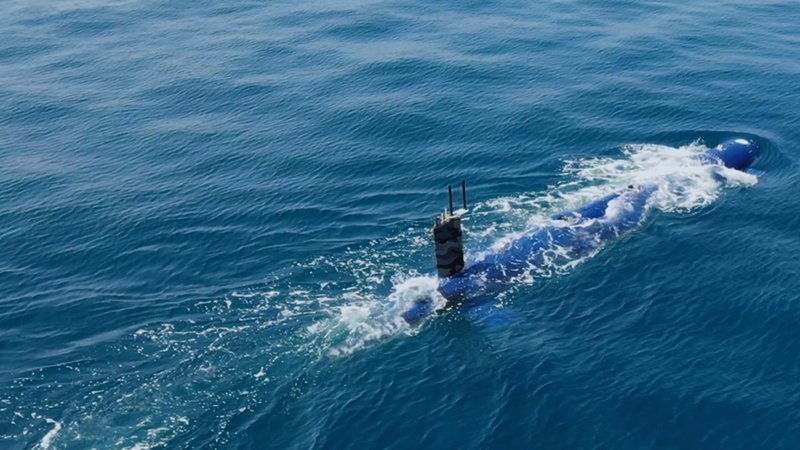
(Photo: IAI-ELTA)
Underwater systems team lead, Captain (Ret.) EE, an experienced naval officer with over twenty-five years at sea in command positions, explains that BlueWhale’s mission capabilities, proven over 2,000 diving hours encompassing a range of successful autonomous missions, add a new dimension to subsurface warfare and make it the first LDUUV to effectively complement larger crewed platforms.
BlueWhale is operated and managed via a highly developed Command & Control (C2) system, which facilitates a continuous Situation Awareness Picture, Call-to-Action commands, events blogger, remote operation and more. A user-friendly Human-Machine Interface (HMI) enables the system to be efficiently operated by only two personnel, a LDUUV operator and a payload (sonar) specialist.
The ability of BlueWhale to complement conventional submarine forces by performing critical missions with complete autonomy reduces crew workload, saves lives, and improves mission performance. This, together with the fact that BlueWhale is less costly to acquire and operate than conventional submarines, make the system a true force multiplier.
Related Equipment in Defence Insight



More from Industry Spotlights
-
![Patria OPTIME and ILIAS: Orchestrating operational readiness across every domain]()
Patria OPTIME and ILIAS: Orchestrating operational readiness across every domain
Patria OPTIME is a sustainment concept that integrates MRO and lifecycle services into one solution, powered by the ILIAS digital defence platform
-
![“Start planning much earlier”: delivering defence support in an era of disruption]()
“Start planning much earlier”: delivering defence support in an era of disruption
In Conversation… The geopolitical landscape is increasingly uncertain, with the UK and its allies confronting the most unpredictable international environment for decades. To adapt, defence readiness must begin long before assets reach the front line, forging a resilient support enterprise that can thrive in a time of ongoing disruption, argue the partners of Team ORION.
-
![Patria NEMO Navy: Unlocking unmatched versatility and protection for modern naval forces]()
Patria NEMO Navy: Unlocking unmatched versatility and protection for modern naval forces
The Patria NEMO Navy mortar system marks a revolutionary advance in maritime defence technology, offering unparalleled benefits to customers who demand performance, adaptability and safety in their naval operations.
-
![“Communicating at mission speed”: why data security is essential for operational success]()
“Communicating at mission speed”: why data security is essential for operational success
In conversation… Everfox’s Chairman and Chief Executive Officer Dave Wajsgras and Managing Director, International, Colin McKinty discuss the critical importance of information security in defence, minimising insider risk and the company’s international growth strategy with Shephard’s Andrew White.
-
![“Engage with the operational problem”: how software innovation can boost UK defence]()
“Engage with the operational problem”: how software innovation can boost UK defence
In Conversation… Shephard’s Andrew White talks to Zafer Şen, CEO and co-founder of OBSS, about the future of command-and-control software in the age of artificial intelligence, and his company’s ambitions in the UK defence market.
-
![“A survivable architecture”: why resilient communications are no longer a luxury]()
“A survivable architecture”: why resilient communications are no longer a luxury
In Conversation… Military communications must adapt to a rapidly evolving battlespace, characterised by decentralised forces and an increasingly contested electromagnetic spectrum. To survive and thrive, it is vital to prioritise resilient systems and networks, Faisal Munir, President – Mission-Critical Communications at L3Harris Technologies, told Shephard’s Gerrard Cowan.