Shipbuilders work at steady clip to meet ROKN requirements
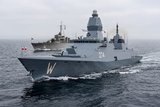
KDX-III Batch 2 An artist’s rendering of the upcoming KDX III Batch 2 class of destroyer. (HHI)
South Korea’s navy is modernising with new vessels at a high tempo, but it is facing manpower shortfalls.


South Korea has an active naval shipbuilding programme, with numerous programmes for the Republic of Korea Navy (ROKN) underway, including submarines, a submarine rescue vessel, frigates and destroyers.
The launch of the ASR-II submarine rescue vessel (pennant number ASR-22) at Daewoo Shipbuilding & Marine Engineering’s (DSME) Okpo shipyard occurred on 7 October. Its construction commenced July 2020, and in mid-2023, it will duly supplement ROKS Cheonghaejin of 1996 vintage.
This 5,600t and 120m-long ASR-II submarine rescue ship will be called ROKS Ganghwado.
As for submarines, DSME declared on 10 September that it had signed a KRW985.7 billion ($887.1 million)
Our news & analysis is now part of Defence Insight®
A Basic-level or higher Defence Insight subscription is now required to view this content.



More from Naval Warfare
-
![Canada assesses security equipment changes for Polar Icebreaker Imnaryuaq]()
Canada assesses security equipment changes for Polar Icebreaker Imnaryuaq
The Canadian Department of National Defence is evaluating communications and reconnaissance changes for CCGS Imnaryuaq’s expanded maritime security role, while retaining its 2032 acceptance target.
-
![All eyes on Royal Navy’s Type 93 market engagement as industry prepares bids]()
All eyes on Royal Navy’s Type 93 market engagement as industry prepares bids
Responses are due by 29 October as the Royal Navy tests the market, with BAE Systems’ Herne and MSubs’ Excalibur setting up a contest where payloads may decide the winner.
-
![US Navy’s MQ-25 Stingray approaches carrier-integration tests]()
US Navy’s MQ-25 Stingray approaches carrier-integration tests
Boeing has outlined its upcoming precision-landing and carrier-airspace trials as MQ-25 manufacturing shifts towards Illinois, with initial Lot 1 deliveries expected in 2029.
-
![From Poland to the Pacific: can Miecznik become a blueprint for other navies?]()
From Poland to the Pacific: can Miecznik become a blueprint for other navies?
Babcock is taking its Polish industrial partnership approach to Denmark and New Zealand as navies seek sovereign shipbuilding skills alongside ships.