SharpEye for next Batch 2 River class OPVs


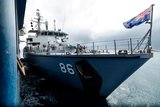
Kelvin Hughes will supply its SharpEye radar systems for the Royal Navy’s two latest Batch 2 River class offshore patrol vessels (OPVs), the company announced on 20 February.
The company was selected to supply SharpEye for the first Batch 2 River class OPVs, HMS Forth, HMS Medway and HMS Trent, in April 2015. This agreement will see the systems also supplied for HMS Tamar and HMS Spey.
Each vessel will be equipped with a SharpEye I-band radar for helicopter control and navigation as well as an E/F-band SharpEye radar for navigation and collision avoidance. Kelvin Hughes will also supply its ARPA widescreen radar display for all vessels. The radar sets will be interfaced with each ship’s combat management system and other third-party systems such as WECDIS and WAIS.
The Batch 2 OPVs have been designed with a Merlin-capable flight deck and a greatly expanded capacity for accommodating troops. They will be deployed in a range of missions including counter-piracy, counter-terrorism and anti-smuggling roles.
SharpEye radar systems provide situational awareness for early warning of larger vessels, small targets and asymmetric threats with a low radar cross section such as RHIBs, small wooden boats, USVs and jet skis. Operating in the I-band, the new radar will enable the ships to distinguish between genuine targets and environmental clutter even in adverse weather conditions.
Barry Jones, Kelvin Hughes regional sales manager, said: ‘SharpEye is an ideal choice for these OPV projects. The system provides a three-in-one approach with a type approved navigation radar using advanced small target detection, a 2D surface surveillance capability and a helo detection mode to aid rotary aircraft recovery in bad weather; all in one compact radar package.
‘Its scalable architecture allows it to satisfy the requirements of the smaller patrol boat as a primary radar or as a navigation radar and secondary surveillance radar on a larger warship.’
Related Equipment in Defence Insight

You may also like
More from Naval Warfare
-
![Suppliers await next step in Australia’s mine warfare transition]()
Suppliers await next step in Australia’s mine warfare transition
Australia’s mine countermeasure capability remains in flux as the Huon-class nears retirement, but accelerated investment in autonomous systems is opening a path for industry.
-
![Can the US Navy ask Indo-Pacific allies to do more while training with them less?]()
Can the US Navy ask Indo-Pacific allies to do more while training with them less?
As the Iran War draws US ships and marine corps units away from the Indo-Pacific, curtailed exercises and a temporary carrier gap are exposing tensions between Washington’s demand for more self-reliant allies and the joint training needed to realise that ambition.
-
![How could Rheinmetall’s GMF 140 fit with ongoing programmes in North America?]()
How could Rheinmetall’s GMF 140 fit with ongoing programmes in North America?
With Canada committed to its River-class replacement and the USN pursuing a lower-cost frigate, Rheinmetall will need to demonstrate where the GMF 140 can fill a capability gap in the North American fleet.
-
![Australian industry programme builds pipeline for Virginia-class sustainment]()
Australian industry programme builds pipeline for Virginia-class sustainment
Australian businesses can now bid to support Virginia-class submarine sustainment in Western Australia, as momentum around the Henderson Defence Precinct also builds.
-
![South Korea, Japan and Turkey vie for US shipbuilding access in future frigate contest]()
South Korea, Japan and Turkey vie for US shipbuilding access in future frigate contest
Washington’s search for a foreign-built frigate could hand South Korea, Japan and Turkey a larger prize than a double-hull order: a foothold inside the US shipbuilding industrial base.