SharpEye radars selected for Royal Navy’s OPVs


Kelvin Hughes has been selected to supply its SharpEye radars for the UK Royal Navy’s River-class Batch 2 Offshore Patrol Vessels (OPV), the company announced on 13 April.
Kelvin Hughes’ integrated radar system consists of an I Band Doppler SharpEye radar that supports helicopter control and navigation as well as an E/F Band SharpEye radar for navigation and collision avoidance. Kelvin Hughes MantaDigital Tactical ARPA displays will run both radars, and the system will be interfaced with the Combat Management System and third party systems such as WECDIS and WAIS.
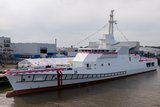
The navy is to receive three OPVs named HMS Forth, HMS Medway and HMS Trent for counter terrorism, counter piracy and anti-smuggling operations. The vessels will enter service in 2017.
Rohan Dearlove, sales director for Europe, Middle East and Africa, Kelvin Hughes, said: ‘Customer navies report that SharpEye radar provides superior surface and air target detection, even in adverse weather conditions, thus greatly enhancing situational awareness and safe navigation.
‘The helicopter detection performance delivered by SharpEye is compliant with the latest MAA regulations without the need for a transponder system such as RRB.’
Dearlove added: ‘SharpEye is Kelvin Hughes’ baseline offering for all RN/RFA programmes including the planned Navigation Radar Portfolio (fleet replacement programme). Our ability to offer variants of SharpEye across both frequency bands to a similar design offers MOD the opportunity to realise significant savings in training, documentation and through life support.’


More from Naval Warfare
-
![Five years on: where could opportunities emerge next for AUKUS Pillar II?]()
Five years on: where could opportunities emerge next for AUKUS Pillar II?
Payload commonality, combat systems and electronic warfare are emerging as likely priorities as the trilateral partnership balances building submarines with sharing industrial ecosystems.
-
![From the Baltic to the Gulf: where USV procurement is heading next]()
From the Baltic to the Gulf: where USV procurement is heading next
Saildrone’s new Copenhagen base is one sign of a larger shift, as navies globally turn to uncrewed vessels for surveillance and mine clearance.
-
![Quantum sensing gathers pace as navies eye undersea advantage]()
Quantum sensing gathers pace as navies eye undersea advantage
As AI dominates defence conversations, industry increasingly points to quantum sensing as the technology set to change submarine and uncrewed underwater vehicle operations.