Serco to support USN anti-terror effort under new technology services contract
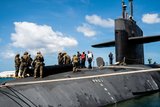
Under the contract Serco will also provide services for the Pentagon at naval bases across the globe.(Photo: Serco)
Serco has been awarded a $200 million contract by the US Naval Information Warfare Center Pacific to provide technology support services for anti-terrorism efforts, including deployment of the Physical Security Information Management System (PSIM).


Under the contract, Serco will continue to provide life-cycle sustainment of physical security/access control and C4I systems to ensure continuous operation and advancement of the PS2-EA, previously known as the Anti-Terrorism/Force Protection Electronic Surveillance Systems.
Additionally, Serco will provide these services for the Pentagon at naval bases across the globe. The scope of Serco’s work extends to installation, integration, testing and evaluation, maintenance, and supply/logistics support.
Additionally, Serco will be deploying the PSIM which is a smart coordinator that integrates data from various security systems and is designed to present information in a clear and accessible manner to the appropriate authorities.
Related Articles
UK looks to Serco to maintain and operate air defence radars
It is designed to provide security personnel with the tools needed to make informed decisions and efficiently manage a spectrum of security technologies, ensuring a robust and effective security ecosystem.
The contract is part of an eight-year, single-award IDIQ contract which was awarded in 2021 and has a five-year base period and one three-year option period with a contract ceiling value of $600 million. In June 2023 the company was awarded a $69 million contract to provide the same services.



More from Naval Warfare
-
![US turns to allies to tackle navy shipbuilding backlog]()
US turns to allies to tackle navy shipbuilding backlog
A White House memorandum acknowledges US Navy shipbuilding backlogs and a weakened industrial base, opening a formal path for South Korean and Japanese yards to help rebuild capacity.
-
![US Navy’s $275 billion BBGN plan hinges on shipyard transformation]()
US Navy’s $275 billion BBGN plan hinges on shipyard transformation
The US Navy’s planned nuclear-powered warship carries a US$275 billion price tag, but the greater story lies in the industrial overhaul needed to build it, from AI-enabled design to digital twins and modular construction.
-
![Europe’s naval contractors benefit from growing refit and upgrade demand]()
Europe’s naval contractors benefit from growing refit and upgrade demand
Rheinmetall’s order to modernise the German Navy frigate Bayern points to a wider European shift towards extending warship service life as new-build programmes face delay.