“We must end the mentality of ever larger platforms”: Why USVs are scaling
Gen Sir Gwyn Jenkins, First Sea Lord, emphasised the importance of technological advancements in enhancing the Royal Navy's capabilities and deterrence against Russian threats in the North Atlantic. (Photo: author)
Multiple USV programme milestones announced last week, aligned with a reinforcement of the Royal Navy’s vision for a hybrid fleet, point to innovation-led ambition but also to a structural calculation with resource ceilings that neither London nor Washington can ignore.


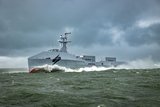
A week rarely arrives in which a single theme runs so clearly. Yet last week delivered it: the US Navy (USN) reportedly outlined plans to field thousands of uncrewed surface vessels (USVs) in the Indo-Pacific; Saildrone unveiled a combat-capable 52m USV with vertical-launch strike capability; Rheinmetall and Kraken Technology Group moved from prototype to serial production; HII announced four additional ROMULUS 151 hulls entering manufacture; and Anduril Industries partnered with Kraken to bring a family of small USVs to USN service.
Delivering the inaugural Lord Fisher Lecture at RUSI on 29 April 2026, Gen Sir Gwyn Jenkins, First Sea Lord, offered a
Our news & analysis is now part of Defence Insight®
A Basic-level or higher Defence Insight subscription is now required to view this content.


More from Naval Warfare
-
![Competitive P17B tender marks a shift in Indian Navy frigate procurement]()
Competitive P17B tender marks a shift in Indian Navy frigate procurement
The Indian Navy's P17B programme is expected to combine greater weapons capacity with a competitive domestic construction model, although key systems could remain dependent on international supply chains.
-
![How France’s SNLE 3G programme is reshaping the naval nuclear industrial base]()
How France’s SNLE 3G programme is reshaping the naval nuclear industrial base
Extending far beyond a four-submarine replacement programme, France’s ballistic missile submarine effort is a decades-long industrial initiative designed to preserve the country’s ability to build and sustain nuclear-powered strategic platforms.
-
![China’s mineral processing dominance exposes naval supply chain vulnerabilities]()
China’s mineral processing dominance exposes naval supply chain vulnerabilities
Competition for critical minerals, and China’s dominance of their processing, is emerging as a decisive factor in future naval procurement programmes.
-
![Suppliers await next step in Australia’s mine warfare transition]()
Suppliers await next step in Australia’s mine warfare transition
Australia’s mine countermeasure capability remains in flux as the Huon-class nears retirement, but accelerated investment in autonomous systems is opening a path for industry.
-
![Can the US Navy ask Indo-Pacific allies to do more while training with them less?]()
Can the US Navy ask Indo-Pacific allies to do more while training with them less?
As the Iran War draws US ships and marine corps units away from the Indo-Pacific, curtailed exercises and a temporary carrier gap are exposing tensions between Washington’s demand for more self-reliant allies and the joint training needed to realise that ambition.