RN will have to play catch-up to achieve hypersonic ambitions
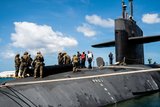
The RN has been criticised for its ships being well-defended but lacking lethality. (Photo: UK MoD/ Crown Copyright)
Comments from the head of the RN about hypersonic ambitions came shortly before UK officials met with their French counterparts to progress the joint Future Cruise/Anti-Ship Weapon project.


In a 10 February speech, the head of the UK RN, First Sea Lord Adm Sir Ben Key, expressed an ambition to make the service a global leader in hypersonic weapons; however, the service will have to play catch-up to meet these ambitions.
The ambition to become a global leader in hypersonic weapons comes after the RN formally cancelled plans to acquire an interim replacement for the Harpoon missile, leaving it with an anti-ship missile capability gap between 2023 and 2028.
Speaking during a visit to Scotland to see the shipyards building the Inspiration-class Type 31 and City-class Type
Our news & analysis is now part of Defence Insight®
A Basic-level or higher Defence Insight subscription is now required to view this content.

More from Naval Warfare
-
![US turns to allies to tackle navy shipbuilding backlog]()
US turns to allies to tackle navy shipbuilding backlog
A White House memorandum acknowledges US Navy shipbuilding backlogs and a weakened industrial base, opening a formal path for South Korean and Japanese yards to help rebuild capacity.
-
![US Navy’s $275 billion BBGN plan hinges on shipyard transformation]()
US Navy’s $275 billion BBGN plan hinges on shipyard transformation
The US Navy’s planned nuclear-powered warship carries a US$275 billion price tag, but the greater story lies in the industrial overhaul needed to build it, from AI-enabled design to digital twins and modular construction.
-
![Industry sees opportunity in Australia’s shift to networked undersea warfare]()
Industry sees opportunity in Australia’s shift to networked undersea warfare
Australia’s new defence innovation strategy indicates a shift from platform-centric to network-centric undersea warfare, with Ocius and Anduril Industries pointing to fast-growing opportunities for local industry.
-
![Asia-Pacific emerges as the largest export market for US-made USVs]()
Asia-Pacific emerges as the largest export market for US-made USVs
Asian customers have placed one of the largest known international purchases of US-built uncrewed surface vessels, highlighting accelerating regional demand for autonomous maritime capabilities and distributed naval operations.