Royal Navy accepts OPV


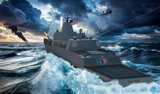
The Royal Navy has accepted the delivery of its newest Offshore Patrol Vessel (OPV), HMS Forth, from BAE Systems at the company’s Scotstoun shipyard.
Forth completed maiden sea trials in December and will now sail to Portsmouth where the vessel will be commissioned into Royal Navy service.
The new OPV fleet will carry out a range of roles for the navy, including counter-terrorism, anti-piracy and anti-smuggling. The rest of the fleet, HMS Medway, HMS Trent, HMS Tamar and HMS Spey, are all expected to enter service by 2020.
The 90m vessels will be equipped with a 30mm cannon and a flight deck capable of receiving a Merlin helicopter. Displacing around 2,000 tonnes, they will have a maximum speed of 24 knots and will be able to sail 5,500 nautical miles before having to resupply.
Defence Minister Guto Bebb said: ‘Thanks to the hard work of the Clyde shipyards, HMS Forth is now ready to join the Royal Navy surface fleet and begin the vital task of defending the UK and her interests around the world.’


More from Naval Warfare
-
![A closer look at the US Navy’s $268 billion investment in shipbuilding by 2031]()
A closer look at the US Navy’s $268 billion investment in shipbuilding by 2031
The recently released USN 2026 Shipbuilding Plan anticipates the procurement of 185 crewed and uncrewed platforms in the next five years.
-
![SAHA 2026: Turkey markets modular undersea systems to European buyers]()
SAHA 2026: Turkey markets modular undersea systems to European buyers
Turkey’s defence industry is pushing a class of platform and building an entire philosophy of cost-imposition around it.
-
![STM’s European wins strengthen Turkey’s naval credibility on the continent]()
STM’s European wins strengthen Turkey’s naval credibility on the continent
Turkish defence and engineering company STM is attempting to challenge Europe’s established naval primes by winning contracts from Portugal to Pakistan – with a business model built on working in any shipyard in the world.